

























































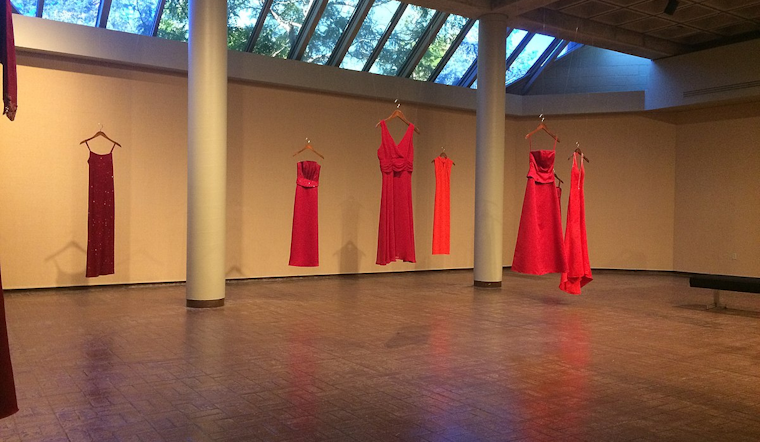
Red dresses are stirring conversations across university campuses in Michigan, symbolizing a powerful campaign for a brutal reality. Northern Michigan University students have launched a "Red Dress Installation" intended to shed light on the ongoing issue of missing and murdered Indigenous women across North America, a movement catching the eyes and hearts of many.
The installation at NMU, spotlighted by WWJ Newsradio 950, features hauntingly empty red dresses representing the epidemic. Describing the showcase, Amber Morseau, director of NMU’s Center for Native American Studies, told the newsroom, “It provides a space for healing as we sing for our Sisters to return home at our Firesite.” Originating from the REDress Project by Métis artist Jaime Black, NMU's demonstration aligns with Black's goal to communicate the disproportionate violence Indigenous women face.
Marquette's university's campaign further emphasizes the severity of the crisis. According to a statement from NMU's Center for Native American Studies, retrieved by WWJ Newsradio 950, "Native women and girls are disproportionately affected by the violence," citing a National Institute of Justice study estimating that 84 percent of American Indian and Alaska Native women have experienced violence in their lifetime.
The red dresses, while a Canadian project, are a significant part of Marquette's community. "Hosting a 'Red Dress Installation' is an important way to highlight the important issue," Morseau added, not just in awareness but in memorial and mourning for the lives lost. Shelby Boggs, Vice President of NMU Native American Student Association, explained in the interview with TV 6, "Red is a really powerful symbol for us of visibility and awareness."
Over at Michigan State University, a similar exhibition commanded attention with 60 dresses undulating in the breeze as part of the same REDress Project. Devon Akmon, the director of the MSU Museum, described the visual impact to upnorthlive.com, "It's hard to avoid the 60 dresses that are blowing in the wind." The dresses serve a dual purpose of remembrance and alerting the public to the staggering injustice faced by Indigenous communities, particularly women and girls.
Although Savanna's Act was signed into law in 2020 to address the crisis, those advocating for action say more needs to be done. Experts argue for stricter enforcement and better protection for Indigenous populations. The red dresses, both in Marquette and East Lansing, remain a somber invitation to reflect, learn, and advocate for those who have been silenced too long.





.jpg)