

























































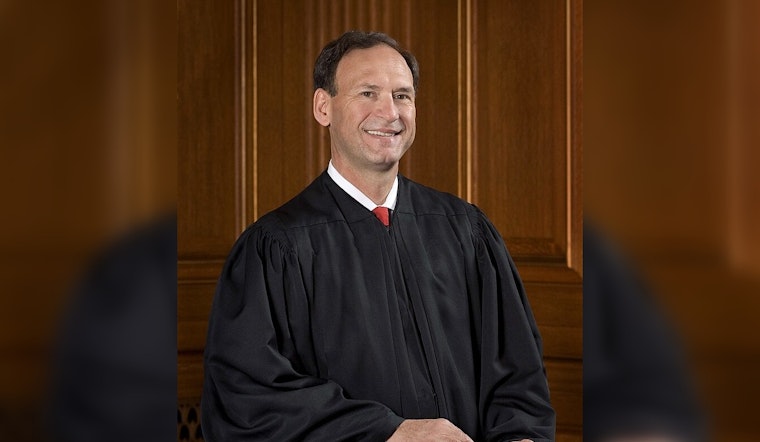
The tug-of-war over Texas' stringent immigration statute took a fresh turn this week when Supreme Court Justice Samuel Alito put the brakes on the state's controversial SB4 law. According to KSAT, Alito extended a hold on the law, which would permit state police to detain migrants suspected of entering the country unlawfully. This move comes just in time as the previous pause was set to expire, prolonging the standoff between federal and state authorities over who has the ultimate say in immigration enforcement.
The disputed law, SB4, would give Texas law enforcement the power to arrest, imprison, and prosecute migrants on state charges related to unlawful entry or reentry into the United States through any means other than designated ports of entry. It even goes as far as to authorize state judges to mandate migrants to return to Mexico as an alternative to facing state prosecution. This piece of legislation, hailed by some as necessary to combat illegal immigration, has opponents decrying it as one of the harshest state-level immigration laws in recent American history. Alito's decision to extend the stay through March 18 was reported by CBS News, providing a temporary barrier against the law's implementation.
At the heart of the legal battle is the contention that SB4 infringes on the federal government's jurisdiction over immigration policy and stands in contrast to U.S. asylum laws. The Biden administration, vocal in its criticism, asserts the law could damage diplomatic relations with Mexico, which has labeled the measure as "anti-immigrant." These federal concerns were echoed in a late February ruling by U.S. District Court Judge David Ezra, who barred Texas from enforcing SB4, acknowledging the administration's stance that the law conflicts with both federal law and the U.S. Constitution.
However, Texas has dug in, defending its legislative action by evoking imagery of defending itself from a purported "invasion" of migrants and cartel activity—an argument roundly rejected by Judge Ezra. His decision to freeze the enforcement of SB4 was then temporarily suspended by the U.S. Court of Appeals for the 5th Circuit at the behest of Texas until Alito extended that hold. With the 5th Circuit set to hear arguments on SB4 come April 3, both state and federal parties are looking ahead to a pivotal clash over the reaches of immigration authority.





