

























































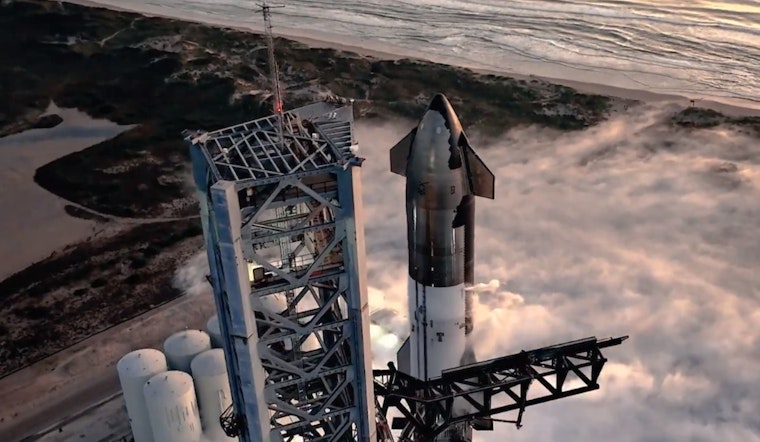
SpaceX's latest test flight of its Starship mega rocket ended in a loss of the spacecraft after a near-completion of its hour-long journey earlier today. According to SpaceX's communications, the vehicle's contact was lost as it was on the cusp of achieving its splashdown target in the Indian Ocean. The mission had set off from the southernmost point of Texas, close to the Mexican border, as reported by Yahoo Finance.
Despite the mishap that occurred 49 minutes into the test, with just minutes left before the planned conclusion of the flight, much of the event unfolded satisfactorily. Coming after two prior attempts last year that ended explosively minutes post-launch, this trial's duration was notable. Flying without any crewmembers or satellites, the towering Starship rocket, standing 397 feet tall, as per reports from FOX San Antonio, successfully separated from its booster, which later splashed down into the Gulf of Mexico.
SpaceX founder Elon Musk had earlier praised his team for their progress, saying, "SpaceX has come a long way," on X, the platform formerly known as Twitter, observed on the day commemorating the 22nd anniversary of the founding of SpaceX. The loss of the spacecraft, however, puts a spotlight once again on the challenges faced by the company in reaching its lofty space exploration goals which involve crewed lunar landings and eventually, human journeys to Mars.
SpaceX has come a long way
— Elon Musk (@elonmusk) March 14, 2024
As NASA observed the flight attentively, their interest manifested due to the critical role Starship plays in the space agency's upcoming lunar missions. In a statement obtained by Yahoo Finance, NASA Administrator Bill Nelson congratulated SpaceX on what he characterized as a successful test flight, highlighting its importance in the Artemis moon-landing program. The Artemis program, named after the Greek goddess and twin sister of Apollo, aims to return human astronauts to the moon's surface, hopefully, by the end of 2026.
Looking ahead, SpaceX has its sights set on utilizing these colossal rockets – designed to be reusable – for initiatives such as launching Starlink internet satellites and hosting private spaceflights. Reflecting on the journey of the mega rocket, Thursday's test marks the progression from a catastrophic inaugural launch last April to an improved but still explosive test in November, before this most recent test that, while not successful, showed notable strides forward. Even with the setback, SpaceX continues to press on towards its goal of redefining space travel as we know it, informed by FOX San Antonio.





