

























































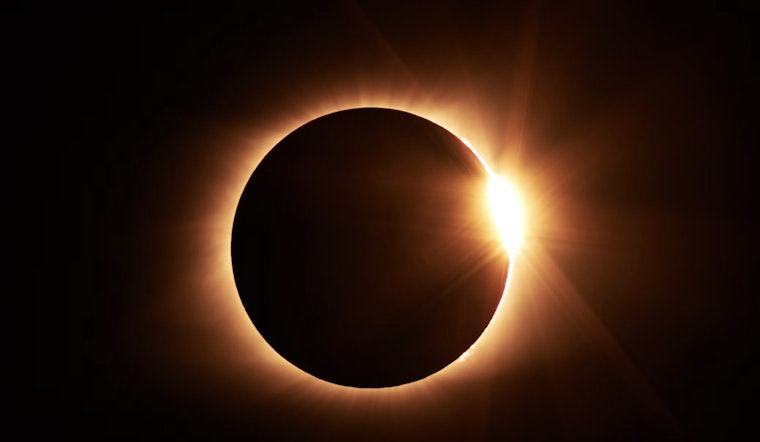
As North America prepares to dip into darkness with the upcoming total solar eclipse on April 8, scientists at MIT's Haystack Observatory are gearing up to closely observe this celestial event's impact on Earth's atmosphere. The eclipse is set to carve a path of totality across the continent, darkening skies from Mexico through Texas and up to Maine and eastern Canada. Over 31 million residents are positioned to witness the total blockage of the sun, while countless others will observe a partial shading, dependent on local weather conditions.
In anticipation of this rare astronomical alignment, researchers are planning to leverage an array of sophisticated instruments to scrutinize changes in the ionosphere, the Earth's uppermost atmospheric layer and home to orbiting satellites. The MIT team aims to not just watch, but to thoroughly study the ionosphere's response to the abrupt fall in solar radiation as the solar eclipse unfolds across different scales. They hope to glean insights into atmospheric reactions to other similar solar phenomena in the future.
Leading the technological coordination for the eclipse observations at MIT Haystack are research scientists Larisa Goncharenko and John Swoboda, who recently detailed their instrumentation plans in an interview with MIT News. Goncharenko, an expert on ionospheric physics, addressed the known effects of total eclipses on the ionosphere, explaining that the moon’s shadow reduces electron density, creating a "hole" that moves with the shadow, accompanied by atmospheric cooling and wind disturbances.
Swoboda highlighted two new radar technologies, Zephyr and EMVSIS, to be used for capturing data on atmospheric alterations due to the eclipse. "The first is Zephyr, which was developed by [Haystack research scientist] Ryan Volz. Zephyr looks at how meteors break up in our atmosphere," Swoboda told MIT News. The second, EMVSIS, will measure plasma density and the movement of charged particles in the ionosphere. These novel systems, along with regional observations from the Millstone Hill Geospace Facility and a network of GNSS receivers, are intended to offer unprecedented four-dimensional data on the upper atmosphere's dynamics.
Goncharenko expressed excitement about the potential findings from this comprehensive observational approach. "I expect to see the unexpected," she proclaimed. Swoboda echoed this sentiment, envisioning the project as a stepping stone towards a continuous radar network comparable to ground-based weather monitoring systems, importantly serving space weather analysis—a growing need due to the increasing satellite traffic in near-Earth space.
This multi-faceted effort by Haystack scientists not only promises to shed new light on the ionospheric response to the April 8 solar eclipse but also to bolster our broader understanding of the upper atmosphere's behavior under various solar disturbances, ultimately supporting the technological demands of contemporary society. The solar eclipse, while an impressive spectacle for sky-watchers, offers researchers a valuable natural laboratory for advancing the science of space weather prediction and atmospheric science.





