

























































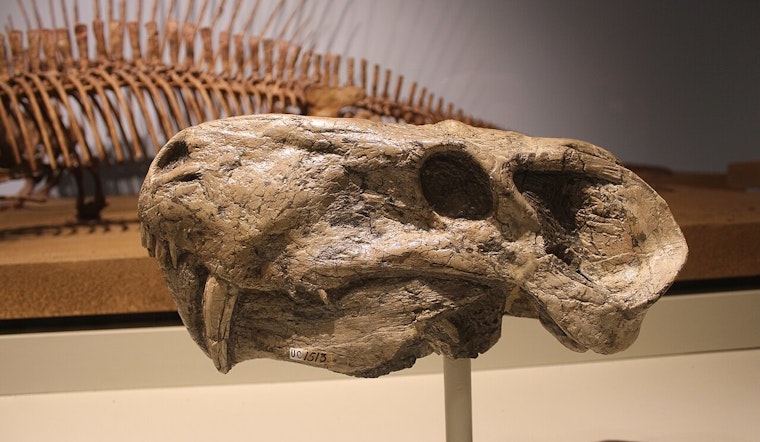
In a remarkable discovery that revises the map of an ancient predator's territory, a fossilized skull belonging to a saber-toothed cat has been uncovered on the Texas coast. According to researchers at the University of Texas at Austin, the find sheds light on the extent of the roaming grounds of the formidable creature that inhabited the Earth tens of thousands of years ago. As reported by KXAN, the fossil offers new insights, suggesting these cats once prowled the land bridge that connected Texas to Florida, now beneath the Gulf of Mexico.
The fossil initially seemed unremarkable—a nondescript calcified lump. However, it was found to contain hidden secrets. “You can’t even tell what it is, let alone which animal it came from,” John Moretti, a doctoral student at the UT Jackson School of Geosciences who led the research, told UT News. X-rays revealed an unerupted canine tooth within the jawbone, indicating the animal was still young when it died. The fossil, turning out to be far more than meets the eye, is analogous to a geode—ordinary on the outside, yet concealing a treasure within.
Hailing from a genus known as Homotherium, the saber-toothed cat was akin in size to a modern-day jaguar and had a distinctive sloping back and bobtail. This specific fossil, demonstrating that these cats once roamed a Neotropical corridor used by species such as capybaras and giant armadillos, provides a snapshot of the region's ecology during the Late Pleistocene. The find signifies a substantial stride in piecing together the prehistoric puzzle of North America's megafauna.
Fossil finds such as this one are essential to paint a more complete picture of ancient ecosystems and the creatures that once inhabited them. "Big carnivores such as these cats helped shape the broader animal community, tamping down prey-animal populations and influencing regional biodiversity," Moretti explained. The research, which has been warmly received by the scientific community, details a prehistoric drama that played out across a landmass now submerged and forgotten.
The fossil specimen itself has a history as intriguing as the animal to which it belonged. Discovered over 60 years ago by then-professor Russell Long, it was eventually donated to the research initiative by U.S. Rep. Brian Babin. "It wouldn’t have been there, and we wouldn’t have that to use as evidence," Moretti reflected on the crucial, preserved state of the canine tooth, as he told UT News. The complete findings are detailed in the May issue of The Anatomical Record, revealing this pivotal chapter of the Homotherium's existence on what is now the Texas coastline.





