

























































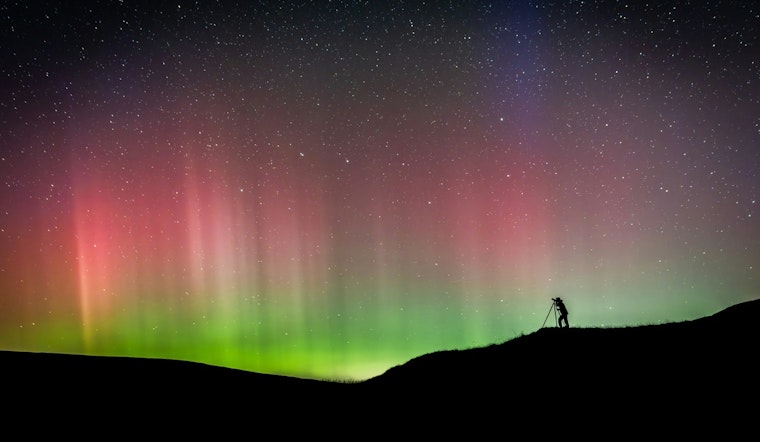
New Englanders were left in awe this weekend as the night skies lit up with the ethereal glow of the Northern Lights, an uncommon occurrence for the region better known for its charming autumns and harsh winters. Typically a spectacle reserved for the Arctic, the colorful auroras were visible due to a significant solar event that prompted the National Oceanic and Atmospheric Administration (NOAA) to issue a geomagnetic storm watch, the first such alert in nearly two decades, Boston25 News reported.
According to experts, the extraordinary display was sparked by a sunspot on the sun's surface, 16 times the Earth's diameter, sending a barrage of plasma and magnetic fields towards our planet, leading to the highest level of geomagnetic storm, classified as G5, or "extreme." As charged particles from the solar storm collided with Earth's magnetic field,, they caused colorful lights to dance across the sky in an array of greens, reds, and purples—a result of these particles interacting with various gases in the atmosphere. CBS News Boston details that collisions with oxygen at different altitudes result in variations in color, from red auroras above 150 miles to the common green auroras up to 60 miles high, while nitrogen collisions contribute to blue and purplish-red hues.
While the celestial event has been a treat for sky-watchers, it also poses challenges due to its potential impacts on modern technology. G5 solar storms are capable of causing significant disruption by inducing geomagnetic currents that may interfere with power grids, satellite operations, and communication systems. Starlink CEO Elon Musk revealed their satellite-based internet service is "under a lot of pressure," as a direct consequence of the ongoing solar tempest.
If the lights evaded you this time around, you might still be in luck. NOAA has indicated Saturday night and Sunday night could offer repeat performances, depending on ongoing solar conditions and, of course, cloud cover. Southern New England may deal with a few clouds tonight, while Sunday night could yield better viewing opportunities as long as the solar energies persist, CBS News Boston explained. They added that such forecasts are weather permitting, always leaving a chance that the auroras could grace the skies once more soon.



