

























































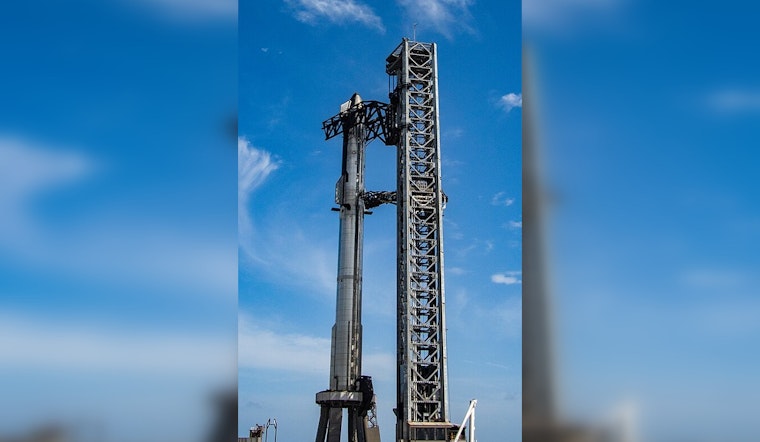
In an assertion that marks a significant step towards the ambitious goal of interplanetary travel, SpaceX's latest Starship prototype successfully completed its highly anticipated fourth launch and managed two targeted water landings. The launch, which took place from the company's Boca Chica, Texas, launch facility, saw both the spacecraft and its rocket booster execute soft touchdowns—a feat that brings SpaceX closer to its vision of reusable space vehicles.
Despite a less than perfect liftoff with one of Starship's 33 booster engines failing to ignite, the mission proceeded to demonstrate the capability to softly land the rocket's booster in the Gulf of Mexico, and the spacecraft in the Indian Ocean, near Australia. As per Elon Musk's statement obtained by the Houston Chronicle, even with "loss of many tiles and a damaged flap," the Starship managed to reach its end goal. The successful deployment of Starship is meant to significantly advance the pace of space exploration, potentially shortening the timeframe on NASA's lunar ambitions and the wider scope of manned Mars missions.
The flight took off at 8:50 a.m. ET and about seven minutes and twenty seconds into the flight, the booster achieved its separation, subsequently making a successful water splashdown as reported. The main spacecraft continued, powering into orbital insertion with its six engines fully engaged. The heat shields played a critical role approximately 49 minutes into the flight, as the spacecraft began its reentry journey into Earth's atmosphere, guiding the vehicle towards its intended splashdown point in the Indian Ocean, as detailed by USA Today.
Though the vehicle suffered some damage upon re-entry, with one of the spacecraft flaps partially ripped and a thermal tile sparking, the Starship managed to successfully light its engines to smoothly land in the ocean amid rounds of applause, as confirmed by a SpaceX announcement: "Splashdown confirmed! Congratulations to the entire SpaceX team on an exciting fourth flight test of Starship!" It's important to highlight that these prototypes are testing critical systems and designs to eventually ensure safe transportation of astronauts to lunar orbit and beyond. A rapid succession of tests has characterized SpaceX's approach, sacrificing hardware in pursuit of the swiftest possible path to a fully functioning, reliable spacecraft.
This latest round of tests has occurred amidst intense scrutiny by various stakeholders including locals, environmental groups, and not least, the Federal Aviation Administration (FAA), which oversees commercial rocket launches. Ahead of Thursday's flight, the FAA indicated new flexibility in its regulatory oversight, according to the Houston Chronicle, announcing three scenarios that would not warrant a mishap investigation despite anomalies upon Starship's return from space. This move was commended by George Nield, former FAA associate administrator, who noted that it signals an increase in federal government flexibility and that this maturing of the process would promote a more expedited advancement of the space industry.
Looking ahead, the success of these test flights is crucial for NASA's projected timeline for returning astronauts to the moon and for the aspirational journey to Mars. As programs like Artemis gain momentum, SpaceX continues to work at a breakneck pace, aiming to match the urgency of space agencies to revive human space exploration on a grand scale.





