

























































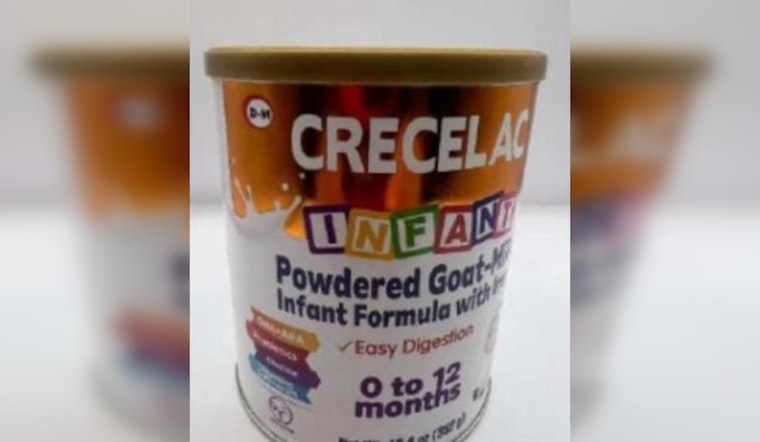
In a recent turn of events, the Food and Drug Administration (FDA) has narrowed down an earlier recall related to baby formula down to a single product offering. Initially, Dairy Manufacturers, Inc., a Texas-based company, was prompted to pull back three of its products from shelves due to concerns over possible bacterial contamination. However, according to the Houston Chronicle, only the Crecelac Infant Powdered Goat Milk Infant Formula has been confirmed to test positive for the Cronobacter spp.
"We sincerely apologize for any inconvenience or concern this may cause and assure our customers that we are taking all necessary steps to ensure the safety, quality, and compliance of our products," was the statement released by the officials of Dairy Manufacturers, Inc. The tainted formula, designed for infants 0-12 months, was sold exclusively through retail outlets within the state of Texas from March to May 2024. The product can be identified by its UPC of 8 50042 40847 6 with a lot code of 24 039 1 CHE 352-1 and expires in August 2025. This recall comes after a sample from the product was found to contain Cronobacter, a bacterium that can cause to be quite dangerous if contracted by infants, leading to conditions such as bloodstream infections, severe developmental delays, motor impairments, and even fatalities.
The much-narrowed recall comes on the heels of a prior, broader caution issued by the FDA. As per details shared by NBC DFW, U.S. health officials had warned parents against using powdered infant formulas distributed by Dairy Manufacturers, Inc., after cronobacter was found in the Crecelac product. The alarm was raised as part of a larger issue that saw a significant recall and shortage of infant formula in 2022, when the same bacteria were detected at a major U.S. formula facility.
Furthermore, the FDA's investigations have revealed that while the Farmalac product did not test positive for cronobacter, parents and caregivers should continue to completely avoid using the formula. These protective measures are echoed by recent history, where 2022 saw a massive disruption when an Abbott formula plant in Sturgis, Michigan, had to be shut down due to a similar bacterial contamination. The closure, which followed cases of infant illnesses linked to cronobacter, including two deaths, caused widespread shortages and prompted the FDA to begin allowing imports of infant formula from foreign manufacturers. This episode starkly highlights the critical importance of stringent safety standards and the need for vigilant oversight in the manufacture and distribution of sensitive products like infant formula.
Consumers who have purchased the affected Crecelac formula are urged to immediately discontinue use and return the product to their place of purchase for a refund. The FDA, while not yet having received reports of adverse reactions from this particular recall, remains cautious and proactive in its approach to public health warnings. For those seeking more information on the recall and the steps to take following such an event, the FDA remains a resource for concerned parents and caregivers.





