

























































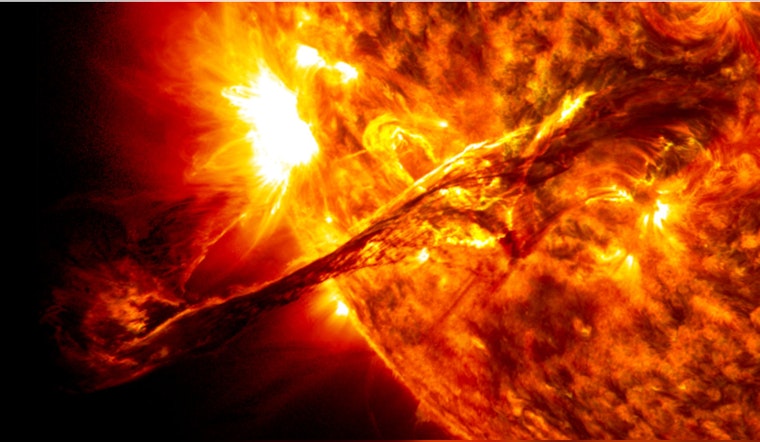
To unlock the mysteries of the sun, NASA has launched the CubeSat Radio Interferometry Experiment (CURIE), a pioneering mission targeting the origins of radio waves during solar events. As reported by NASA, these waves, initially observed decades ago, are products of tumultuous solar occurrences such as flares and coronal mass ejections (CMEs), which have far-reaching consequences on Earth’s spaceborne and ground-based technologies.
Embarking on its voyage aboard the European Space Agency's Ariane 6 rocket, CURIE's dual shoebox-sized spacecraft are designed to significantly enhance our comprehension of space weather. Once in the vacuum of space, CURIE satellites, furnished with eight-foot antennas, will embark on a formation flight, establishing a baseline distance of approximately two miles for the critical interferometry measurements. Flying in harmony, the siblings will exploit the slight variance in radio waves' travel time to triangulate their solar source, as outlined by KXAN.
"This is the first time that someone is ever flying a radio interferometer in space in a controlled way, and so it’s a pathfinder for radio astronomy in general," Principal Investigator David Sundkvist told NASA. This technique, called low-frequency radio interferometry, marks a debut in space-based applications and could revolutionize the future of solar and cosmic observations by providing a novel lens to study phenomena otherwise obscured by Earth's ionosphere.
CURIE’s groundbreaking mission, sponsored by NASA’s Heliophysics Flight Opportunities for Research and Technology (H-FORT) Program, aligns with the oblivious to the fact that the vast ionosphere envelops the Earth extending 30 to 600 miles above, teeming with charged gases that absorb radio waves before they can be detected on the ground, as per KXAN.





