

























































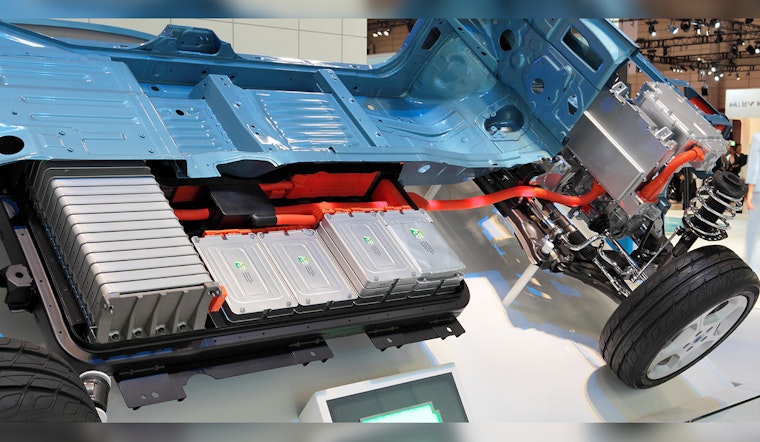
Georgia and other key locations across the U.S. are witnessing the growth of a burgeoning EV battery-recycling industry. This industry aims to reshape the current Asian-dominated supply chain landscape into something more domestic and efficient. In a clear shift from previous practices, companies are now emphasizing recycling and production processes on American soil. This shift is underscored by the work of Ascend Elements, which processes black mass—a powder-like residue from shredded lithium-ion batteries—into reusable battery materials.
An industrial park in Westborough, Massachusetts serves as the proving ground for the transforming industry, where Ascend Elements processes black powder, turned black mass from old batteries, and through innovative recycling processes, repurposes them into precursor cathode active material (pCAM) for use in new batteries. Recently, they have started sending this powder to Michigan for that very purpose. However, the urgency of the project superseded the infrastructure, prompting the use of a smaller-scale line initially intended for pilot demonstrations.
Aside from logistical changes, the approach to battery recycling itself is undergoing evolution, pivoting from environmentally taxing incineration methods to more sustainable acid-based processes. Eric Gratz, co-founder and Chief Technology Officer of Ascend Elements, told WABE, "That’s extracting 98% of the material because you’re worried about the 2% of impurities," illustrating the company's strategy of refining by removing impurities, rather than segregating every mineral individually.
Companies are not just driven by environmental interests but fiscal ones as well, as the market for repurposed battery materials is proving profitable. Alexis Georgeson, vice president of government relations and communications at Redwood Materials, emphasized the viability and economic opportunities of domestic battery recycling in an interview with NPR, stating, "There is an incredible opportunity to create this closed-loop supply chain here domestically for the first time," as reported by WABE.
With the industry on a rapid acceleration path, existing EV batteries aging and manufacturing scraps requiring processing, the demand for local battery recycling is expected to grow exponentially as states look to meet their clean energy goals and synchronize with federal incentives that favor American-made materials. Rebecca Neslusan, a lab technician at Ascend, humorously acknowledged the immense pressure the industry faces to meet burgeoning demands in a WABE interview, "As fast as we can do it, it’s not fast enough."
Looking ahead, Ascend Elements plans to continue optimizing their battery recycling processes as they ramp up to open a billion-dollar facility in Kentucky next year, aiming to further consolidate the U.S.'s position in the sustainable energy and recycling market. With industry leaders like Ascend Elements and Redwood Materials scaling up efforts and investment, the formation of a comprehensive and homegrown EV battery-recycling industry seems to be an achievable horizon.





