

























































MIT researchers are leading the charge in refining the performance of quantum materials, crucial for advances in technology such as superconductivity and quantum computing. According to a recent MIT news article, a team under the guidance of Mingda Li, an associate professor in the Department of Nuclear Science and Engineering (NSE), developed a method to precisely adjust the electronic properties of Weyl semimetals, a subset of quantum materials. The group's findings were published in an open-access paper in Applied Physics Reviews.
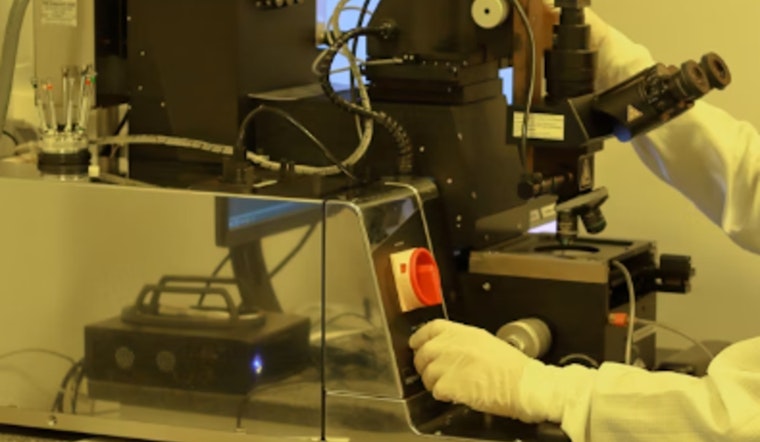
Weyl semimetals, often tricky to work with due to their intricate electronic structures, offer unique advantages including topological protection that maintains key qualities even amid disturbances. Describing this, Abhijatmedhi Chotrattanapituk, a PhD student and lead author of the paper, told MIT News, "When you try to fabricate this kind of material, you don’t have to be exact. You can tolerate some imperfections, some level of uncertainty, and the material will still behave as expected." The MIT team's technique centers on doping - the process of introducing impurities to alter a material's properties - to precisely manipulate the Fermi level, which dictates the material's electrical characteristics. Utilizing MIT's "Tandem" ion accelerator, the team bombarded a tantalum phosphide (TaP) crystal with hydrogen ions to adjust its Fermi level with unprecedented accuracy.
The methodology is not confined solely to Weyl semimetals. NSE postdoc Manasi Mandal, who also led the research, revealed that the technique is applicable "for any inorganic bulk material, and for thin films as well." Precision doping stands to greatly expedite the tuning process, potentially achieving what could have previously taken weeks in mere minutes. Moreover, the researchers have buttressed their experimental approach with a theoretical model that accurately predicts the required doping levels, simplifying the task significantly.
This advance heralds a substantial leap forward for quantum material applications. "The ability to precisely control the Fermi level of a topological material is an important milestone," stated Thomas Zac Ward, a senior scientist at the Oak Ridge National Laboratory, emphasizing its significance for the development of new quantum information systems and microelectronics. With a more accurate means to finely tune materials at their disposal, scientists can enhance the performance of thermoelectric devices and, potentially, increase the critical temperature for superconductivity, a holy grail for energy transmission. As MIT's Li succinctly puts it, "When it comes to quantum materials, the Fermi level is practically everything."





