

























































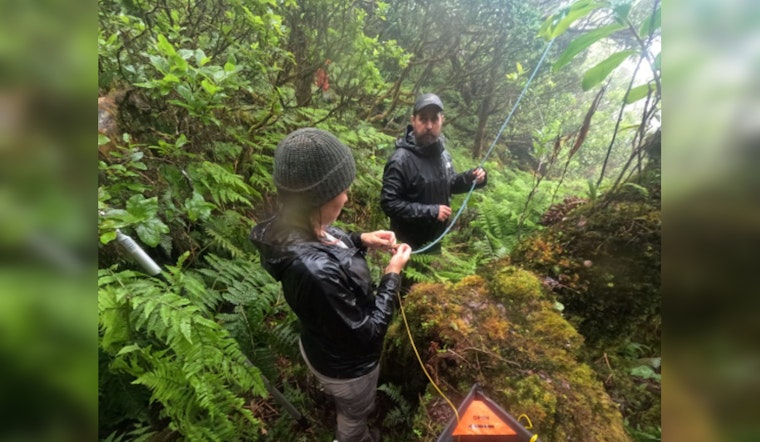
In a significant stride for conservation on Kaua‘i, the National Science Foundation and the Paul G. Allen Family Foundation have earmarked funds specifically to buoy ongoing efforts to combat avian malaria impacting the Hawaiian honeycreepers. A total of $644,758 has been bestowed upon the Kaua‘i Forest Bird Recovery Project in grants announced this week, as reported by the Department of Land and Natural Resources.
The University of Hawai‘i, alongside the U.S. Geological Survey, has similarly received an equivalent grant. These funds are intended to support their continued endeavours, spearheading research to thwart mosquito reproduction and, thereby, cut the chain of disease transmission to the honeycreepers. Dr. Lisa ‘Cali’ Crampton of the Kaua‘i Forest Bird Recovery Project expressed enthusiasm in a statement obtained by the Department of Land and Natural Resources "We are very excited to be involved in this effort to use top-notch science to help us advance conservation of critically endangered forest bird species through reduction of mosquito-borne disease."
This research is just one among 10 projects benefitting from grants under the Partnership to Advance Conservation and Practice program, a collaborative initiative from National Science Foundation and the Paul G. Allen Family Foundation now in its sophomore year. The program is lauded for fostering deep collaboration between those delving into fundamental science and conservation partners actively engaged in field efforts.
With stakes high for biodiversity, Lara Littlefield, executive director for programs and partnerships at the Paul G. Allen Family Foundation, remarked on the broader implications of such in-depth studies, "The fundamental knowledge these projects create, even though related to specific species, will unlock innovative conservation efforts across a broader range of threatened species and ecosystems." Each project under the Partnership to Advance Conservation and Practice program bridges basic science with immediate conservation measures to plug critical knowledge and data vacuums, thus magnifying their real-world conservation impact, as per Department of Land and Natural Resources.
Underscoring the gravity of such collective measures, David Smith, Department of Land and Natural Resources Division of Forestry and Wildlife Administrator, noted the precarious future of the native Hawaiian forest birds. He commented on the importance of the grant in light of the imminent danger of extinction looming over certain honeycreeper species, as he told the Department of Land and Natural Resources, Hawaii, "This grant builds on the strong multi-partner collaboration already in place to combat avian malaria as the single-largest threat facing native forest birds, like the honeycreepers. Every little bit helps, particularly currently, when we are facing the strong likelihood of one or more species of honeycreepers going extinct in the very near future."




