

























































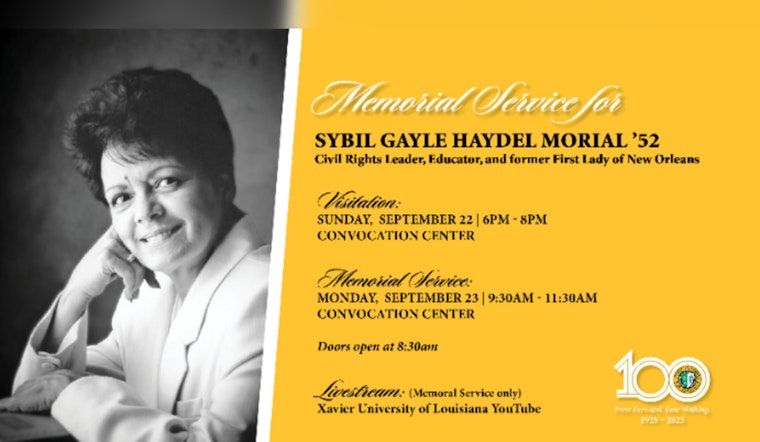
On Sunday evening, a vast array of individuals—from community members to city leaders—gathered at Xavier University to honor the late civil rights advocate Sybil Morial, who passed away at the age of 91. As reported by FOX8, the widow of New Orleans' first Black mayor, Ernest Morial, left an indelible mark through her work and advocacy, which was celebrated at the Xavier University Convocation Center.
Further commemorating her influence, the funeral service on Monday saw a packed house at the same university, with attendees honoring the matriarch of one of the city's most notable political families. United States Senator Mary Landrieu was amongst the mourners and, as WDSU reported, captured her essence by stating, "She was not only a witness to change; she was the change." With her passing earlier this month, the community reflected on her role as an activist, educator, author, and a champion for civil rights.
The rich legacy of Sybil Haydel Morial, who worked as associate dean at Xavier University for 28 years, stretches beyond her tenure in academia. In response to being excluded from the League of Women Voters due to her race, Ms. Morial created her own voting rights group, the Louisiana League of Good Government, emphasizing her commitment to activism and equality. The New York Times recounted this as just one instance of her frontline advocacy during a pivotal moment of transformation and opposition in New Orleans.
Her family's contributions to politics and civil rights continue to resonate in the city and beyond, with her son Jacques Morial confirming her passing, and her son Marc Morial serving as a former mayor of New Orleans and the current president of the National Urban League. Following her death in a New Orleans hospital, many have come forward to recognize the significant barriers she and her husband dismantled, changing the course of the city's historical landscape.




