

























































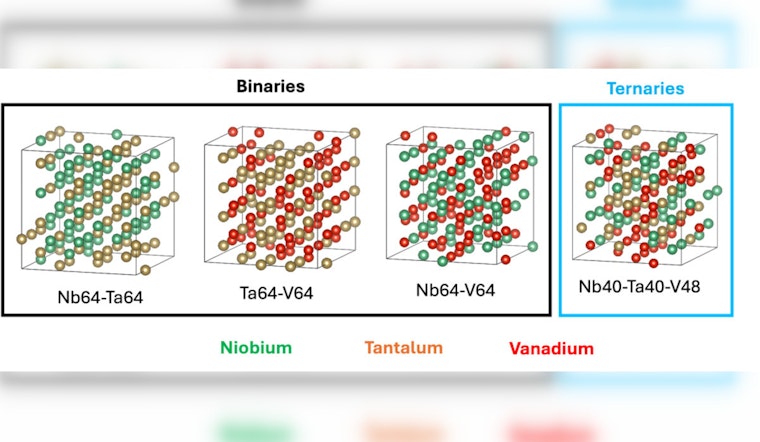
In an effort to enhance the shielding capabilities of nuclear fusion reactors, artificial intelligence is playing a pivotal role. A recent report by Oak Ridge National Laboratory (ORNL) revealed that AI models are being developed to streamline the search for suitable new alloys. Standing at the forefront of this technological stride, researchers used AI to pinpoint novel alloy combinations that could endure the extreme conditions within fusion facilities.
Former AI Initiative Director David Womble initially spearheaded this endeavor, which Massimiliano Lupo Pasini, an AI data scientist at ORNL, has continued with vigor. Lupo Pasini emphasized the need for materials that can sustain exceptional performance at very high temperatures, essential for housing nuclear fusion components. Tungsten alloys, although heat resistant, have shown erratic shielding efficacies, necessitating the quest for alternatives.
Guiding the material scientists away from a lengthy cycle of trial and error, the AI model is set to carry the heavy lifting, enabling the rapid identification of prospective alloys. Lupo Pasini, along with colleagues German Samolyuk, Jong Youl Choi, Markus Eisenbach, Junqi Yin, and Ying Yang from various ORNL directorates, focused their expertise to generate a substantial database for this purpose. Together, they have identified three new elements for potential incorporation into alloy formulations.
The team's work is only part of a larger scientific picture, according to the ORNL report. Lupo Pasini alludes to the challenges of quantum mechanical calculations, which are very expensive to run on existing supercomputers. Also, despite the extensive computational hours across Perlmutter and Summit supercomputers, more research utilizing the generated data is to follow.
Looking ahead, researchers will focus on training the AI model to expedite the discovery of compounds derived from mixing six key elements in varying concentrations to form alloys. “We are trying to help the material scientists with their trial-and-error approaches in identifying the relative percentage of the different elements that need to be mixed together in order to come up with alloys that can lead to disruptive technological advances in fusion,” Lupo Pasini said, as per ORNL.
The endeavor has been financially supported by the ORNL Laboratory Directed Research Development's AI Initiative. UT-Battelle, which manages ORNL for the Department of Energy’s Office of Science, sees this collaboration as part of a grander scheme to tackle some of the most pressing scientific challenges of the current time.





