

























































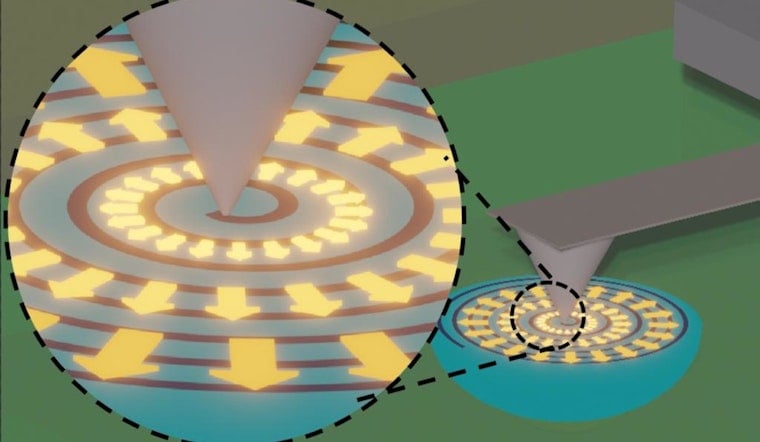
Scientists at the Department of Energy's Oak Ridge National Laboratory are pioneering a nanoscale technique set to enhance materials for cutting-edge memory storage applications and neuromorphic computing systems. According to an announcement from Oak Ridge National Laboratory, the team, led by Marti Checa, has developed a new method for arranging atoms in ferroelectrics, which are materials with switchable electric properties.
The research focuses on the manipulation of atomic orientations, creating what are known as topological polarization structures that have the potential to streamline advances in technology by using an electric stylus. While ferroelectrics typically assume a certain electric field orientation, Checa's team has discovered a way to rearrange these orientations precisely, fostering innovations in information storage and alternative computation methodologies. In a statement obtained by Oak Ridge National Laboratory, Marti Checa said, “Our approach fosters innovations by facilitating the on-demand rearrangement of atomic orientations into specific configurations known as topological polarization structures that may not naturally occur.”
Ferroelectric materials are key to progress in nanoelectronics and 6G mobile communication technologies, as they can retain data without power and reduce energy consumption for switching states. The advancements detailed by the ORNL research team signify a leap forward in the development of high-density, energy-efficient computing systems that could be a game-changer for the tech industry. The technique used by researchers can manipulate electric dipoles within the materials, similar to drawing on magnetic boards, to create complex structures with low power requirements and high-speed capabilities.
Significantly, the study moves beyond the dual-choice, energy-intensive framework of modern binary computing by introducing topological polarization structures that can rapidly alter their polarization states. These structures possess high stability with low energy consumption, which is pivotal when it comes to accommodating the intricacies involved in the transition to 6G technology. “Local modification of the atoms and electric dipoles that form these materials is crucial for new information storage, alternative computation methodologies or devices that convert signals at high frequencies,” Checa told Oak Ridge National Laboratory.
The ORNL-led team has also examined the delicate balance between the mechanical and electrostatic energy in ferroelectrics, providing insights into controlling material behavior with greater precision. By integrating data from correlative microscopy techniques and phase-field models, the researchers can predict and control the material's behavior with nanoscale accuracy. “By combining specially designed electric stylus tip movements with automated experimental setups, we’ve demonstrated the ability to explore new and complex states of ferroelectric materials that weren’t accessible before. A key aspect of this accomplishment is that it allows for a better understanding and control of these materials’ unique properties,” Checa said in the ORNL announcement.
This research, supported by the Center for Nanophase Materials Sciences at ORNL, affirms the Department of Energy’s commitment to furthering basic research in the physical sciences. As the Oak Ridge National Laboratory continues to address some of the most pressing technological challenges of our era, the breakthroughs brought forth by their researchers could pave the way for future innovations.





