

























































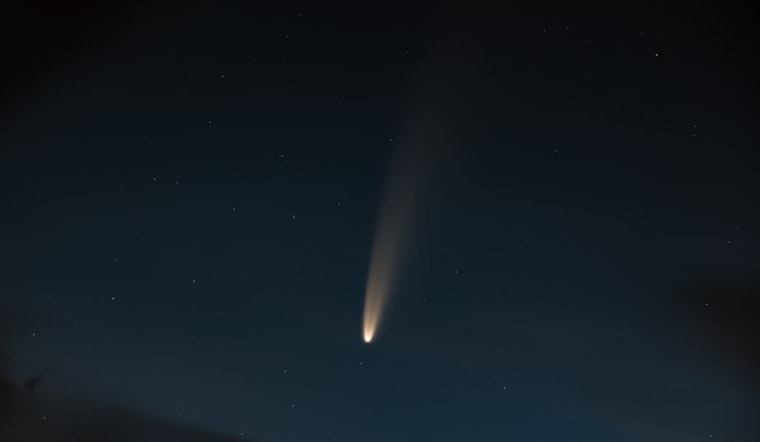
San Antonio residents and sky-watchers are in for a celestial treat, as a rare comet graces the twilight skies this month. The comet, known as C/2023 A3 Tsuchinshan-ATLAS, will quickly become the spectacle of the night on Friday through the end of the month, according to KSAT. Visible just after sunset, the best times to catch a glimpse of this cosmic snowball are expected to be between 7:40 p.m.-8:00 p.m.
For those excited to spot the comet with their own eyes, the recommended viewing strategy is to look to the western horizon approximately 40 minutes subsequent to sunset. The comet's initial presence will be subtle, seen as a hazy star just to the right of Venus, which is often the brightest object in the evening sky this time of year. Those hoping to catch a detailed view should to definitely bring along a pair of binoculars, Bill Cooke, lead of NASA's Meteoroid Environment Office, told TPR.
The allure of C/2023 A3 Tsuchinshan-ATLAS lies not only in its rarity but also in its origin. Discovered independently by teams in China at the Purple Mountain Observatory and in South Africa via the Asteroid Terrestrial-impact Last Alert System (ATLAS), the comet hails from the distant Oort Cloud, a reservoir of icy bodies on the edge of our solar system. As it makes its close approach of 44 million miles to Earth, the comet's ice is vaporized by the sun, leaving behind a spectacular trail of dust and gas.
Beyond its initial appearance, the comet promises to continue to captivate viewers as it climbs higher each evening. However, as noted by KSAT, the comet will only be visible for a brief time at dusk. Those missing the initial appearances shouldn't despair. The comet is expected to progressively brighten until its peak next week from October 14-18. But take note, after Halloween, the cosmic visitor will dim to the point of necessitating a professional telescope to behold its beauty.
Despite the current excitement, the celestial event bears a bittersweet undertone. After its departure this month, C/2023 A3 Tsuchinshan-ATLAS isn't due back for another 80,000 years, making this a truly once-in-a-lifetime occurrence, with no other comets projected to be visible in the near future. "Bright comets are very rare and are usually newcomers to the inner solar system," said Cooke in his statement to TPR, underscoring the singular nature of this cosmic event.





