

























































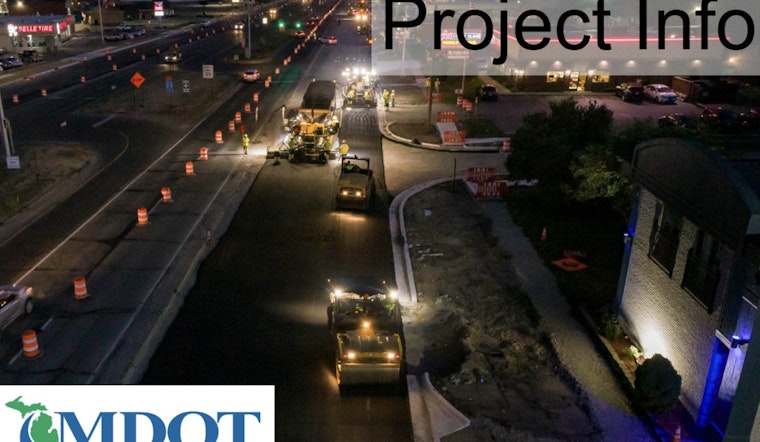
The long-awaited completion of the Telegraph Road and Eight Mile Road diverging diamond interchange (DDI) in Southfield, Michigan, is expected to be fully operational early this week, according to the Michigan Department of Transportation (MDOT). The project, which cost $54 million, marks the end of a significant road upgrade designed to ease traffic congestion and improve safety, as per FOX 2 Detroit.
Starting Monday, drivers navigating the interchange will encounter 18 new traffic signals designed to streamline maneuvers and reduce wait times when entering or exiting the busy US-24 (Telegraph Road) and M-102 (8 Mile Road), although only two lanes will be open for northbound and southbound travel until mid-December when the transition to four lanes is slated for both directions, which will help ease the travel and the new traffic setup is meant to smooth the process of turning left without facing oncoming traffic by shifting lanes first left then right under the M-102 (8 Mile Road) bridge noted Michigan Department of Transportation.
This is the region's first diverging diamond interchange (DDI), a design known for reducing vehicle conflict points, promoting safer, lower-speed travel, and improving overall traffic flow. These benefits are in line with MDOT's previous DDI projects in other parts of Michigan, including the I-96/Cascade Road interchange in Grand Rapids and the I-75/University Drive interchange in Auburn Hills.
The project goes beyond the DDI itself, encompassing a complete rebuild of 1.4 miles of roadway between Eight Mile and Grand River, upgrades to five bridges, drainage improvements, water main work, and sidewalk enhancements to comply with Americans With Disabilities Act (ADA) standards. These efforts aim to improve traffic flow while also creating a safer and more inclusive commuting environment for drivers, pedestrians, and nearby communities.
The project is expected to support a total of 653 jobs, both directly and indirectly, providing a significant boost to the local economy and serving as a model for how modern infrastructure can drive broader economic growth, as noted by Michigan Department of Transportation.



