

























































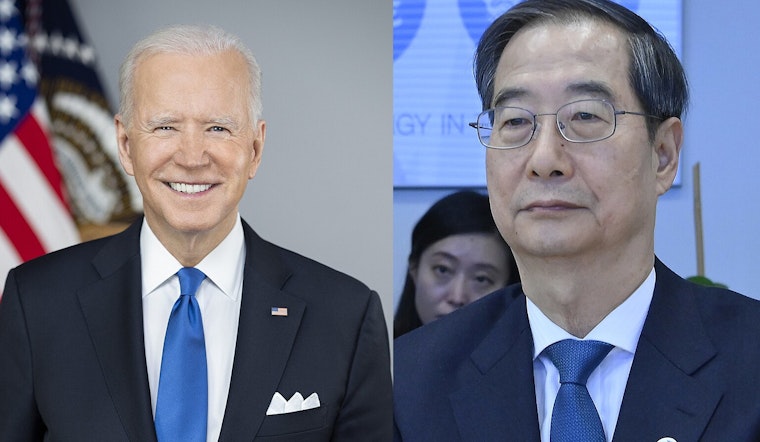
Yesterday, President Joe Biden had a discussion with Acting President and Prime Minister Han Duck-soo of South Korea, underlining the fortitude of democratic values and the rule of law in the Republic of Korea. The White House released a statement detailing the conversation, where President Biden "expressed his appreciation for the resiliency of democracy and the rule of law in the ROK" and reassured the unwavering partnership between the U.S. and South Korea.
The discussion also touched on the advancements achieved in bolstering the U.S.-ROK Alliance. Biden is confident that the alliance will continue to be a cornerstone for tranquility and prosperity in the Indo-Pacific region during Han's tenure. However, it's key to note, any possible to understate, the complexity of the geopolitical environment that envelops the region, where tensions and the potential for conflict are ever-present.
The alignment between the United States and the Republic of Korea holds significant strategic importance, especially in light of the challenges posed by neighboring North Korea and the broader geopolitical shifts in the region. As such, Biden's reaffirmation of this "ironclad commitment" to South Korea is not just routine diplomacy, but also a statement of intent in a global game of power dynamics.
The U.S.-ROK Alliance has indeed made considerable strides in recent years, a fact underscored by both leaders. As the White House statement mentioned, Biden "discussed the tremendous progress we have made toward further strengthening the U.S.-ROK Alliance in recent years." The reliability of such alliances in uncertain times can serve as a reassuring beacon for many, particularly as global powers continually to navigate an increasingly complex and multipolar world stage.
This dialogue between President Biden and Acting President Han underscores the consistent approach the U.S. is taking in its foreign policy in East Asia, seeking to maintain a steady hand in partnerships amidst global and regional shifts. It reaffirms the enduring bilateral relationship that has implications for security, economic ties, and diplomatic cooperation in the Indo-Pacific sphere. As administrations change and global events unfold, the steadiness of such relationships becomes all the more pivotal in the calculus of international relations.





_(52883547261)_(cropped).jpg)