

























































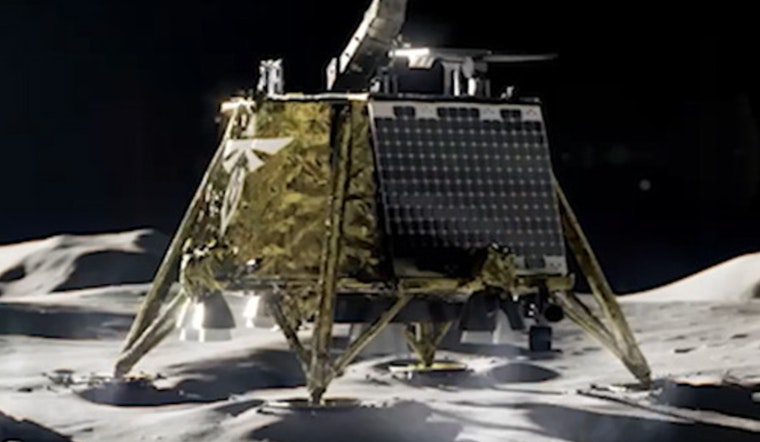
Central Texas-based Firefly Aerospace marked a significant achievement in space exploration, as Cedar Park's own Blue Ghost Lunar Lander was successfully launched into orbit aboard a SpaceX Falcon 9 rocket earlier this week. After lifting off from Cape Canaveral, the spacecraft, constructed and controlled by Firefly Aerospace, is now on a 45-day trajectory to the moon, with critical scientific missions ahead.
The lunar lander's journey involves an intricate path: initially orbiting Earth for 25 days, with increasing orbit lengths, followed by a four-day transit to the moon before settling into lunar orbit for 16 days. During its space operations, the lander will perform experiments, one of which tests the feasibility of employing Earth’s GPS signals on the Moon, and another to assess a computer's resistance to radiation, as detailed in a KXAN report.
Kevin Scholtes, Firefly Aerospace's Deputy Program Manager, commented on the groundbreaking nature of the mission, telling KXAN, “This is the first decade that we’re seeing a commercial enterprise and a commercial push out to the moon, and really, a US return to the moon in general.” The mission is not only a significant technological endeavor but also a leap forward as part of NASA's Commercial Lunar Payload Services initiative, aiming to gather valuable research data for broader space exploration goals.
Upon reaching the lunar surface, the Blue Ghost Lunar Lander is scheduled to execute a variety of experiments, such as drilling and X-ray imaging, for two Earth weeks. These activities are vital to understanding the moon's properties and assisting NASA’s Artemis Mission, which aims to establish a sustainable human presence on the lunar surface and, eventually, to propel astronauts to Mars. Firefly Aerospace's Scholtes expressed his satisfaction about the mission in an interview with FOX 7 Austin, noting the company's role in what has historically been a national undertaking and now sits, a source of local pride in Cedar Park.
Sharing the spotlight on the Falcon 9's payload was another lunar lander, "Resilience," built by the Japanese company ispace. This craft represents ispace's second attempt at a soft Moon landing, with an expected arrival at the lunar surface in 3-5 months. These parallel missions underscore a growing emphasis on commercial contributions to space exploration while expanding the international efforts aimed at lunar research and expeditions.





