

























































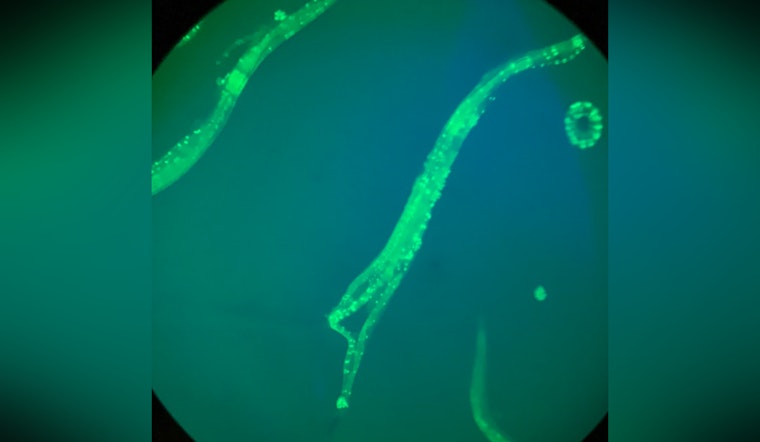
MIT Associate Professor Steven Flavell is using the roundworm C. elegans, which has 302 neurons, to study motivated behaviors like feeding and navigation. His lab’s research on the neural and molecular mechanisms in these worms aims to shed light on how similar behaviors are controlled in humans, noting that "These pathways are evolutionarily ancient," according to MIT News.
Flavell's early work focused on Alzheimer's disease, which led to research on neuronal development and synaptic plasticity in mice. During his postdoctoral fellowship, he studied the neural connections of C. elegans, a roundworm with 7,000 synapses. The simpler, well-mapped brain of C. elegans allows for the tracking of behavior alongside neuronal activity, providing insights into adaptive behaviors, as reported by MIT News.
Flavell's research on C. elegans has created a detailed "atlas" of the serotonin system, showing how serotonin affects brain activity and behavior. He states, "Our studies of how the serotonin system works to control behavior have already revealed basic aspects of serotonin signaling that we think ought to generalize all the way up to mammals." His interdisciplinary team at MIT uses a mix of physics, biology, and neuroscience to develop tools and techniques to study and modify C. elegans neurons, as stated by MIT News.





.jpg)