

























































New Yorkers will have the opportunity to observe several celestial events this month, including a full lunar eclipse, a solar eclipse, and a potential planetary alignment just after sunset, depending on weather conditions. According to Gothamist, the full lunar eclipse is set to begin just before midnight on March 13, reaching its peak with a red-colored moon. This will be the only lunar eclipse visible from New York City this year.
For those observing the event, the eclipse will begin at 11:57 p.m., with the total phase occurring between 2:26 a.m. and 3:31 a.m., when the moon will be fully immersed in Earth's shadow, resulting in the red-hued effect known as a "blood moon." This will be the first such event visible in New York since 2022. According to a statement obtained by Spectrum News, the eclipse timings for upstate New York on March 14 include the partial eclipse beginning at 1:09 a.m. and concluding at 6:00 a.m., subject to weather conditions.
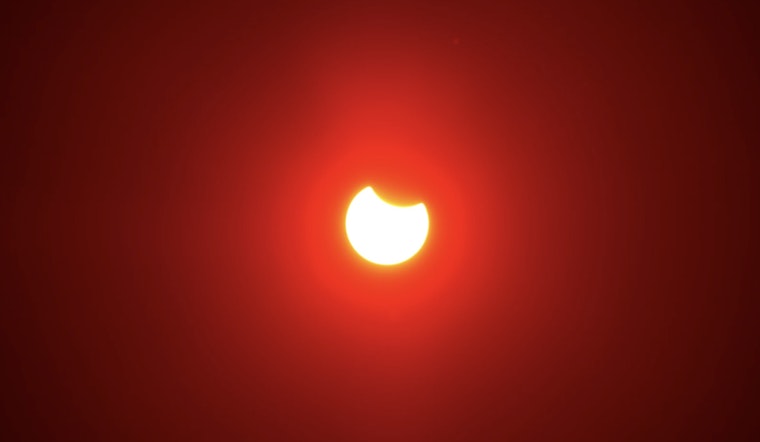
The solar eclipse will take place on March 29, with approximately 30% of the sun obscured by the moon at sunrise. "If you wake up on the morning of March 29 and watch the sun rise, you'll notice that the sun is rising with a little bite taken out of it because the moon will be partially eclipsing the sun for us," Jackie Faherty, an astrophysicist at the American Museum of Natural History, told Gothamist. Viewers are reminded to wear proper eclipse viewing glasses to safely enjoy the phenomenon.
The early nights of March offer opportunities to observe planets such as Mercury near the western horizon alongside Venus, with March 7 identified as a favorable time for viewing Mercury. As the month progresses, rising temperatures and later sunsets will shift viewing times for celestial events. According to a Spectrum News report, the start of daylight saving time on March 9 will further extend daylight into the evening.
Amid these astronomical events, NASA has revised the probability of asteroid YR4 impacting Earth, lowering it from 2% to nearly zero. According to Faherty, the asteroid is no longer considered a significant concern. Current projections indicate a small possibility of it striking the moon in 2032, which could result in a crater but is not expected to affect the lunar orbit.




