

























































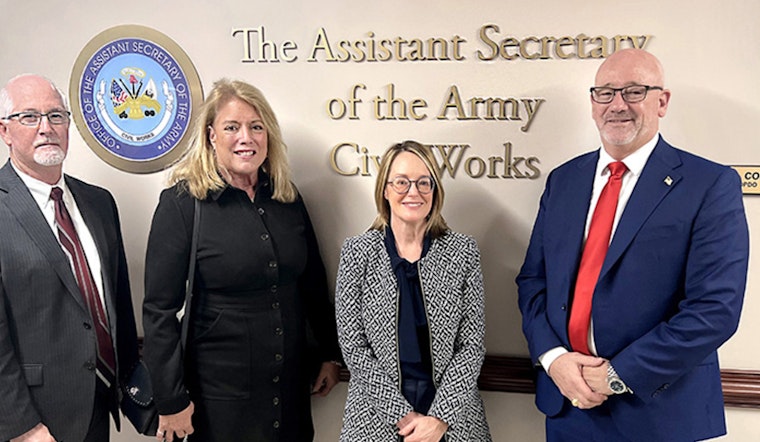
A group from Pinellas County made tracks for Washington, D.C., this week looking to score federal funds for beach restoration efforts that would bolster the area's coastline against the ravages of nature and economic fallout. The delegation, which included County Commissioner Kathleen Peters, argued the case for the renewal of federal support, crucial in the battle to protect Pinellas's tourism-dependent economy and its coastal infrastructure.
According to a statement obtained by the Pinellas County Government's news release, the meetings held at the White House, Capitol Hill, and the Pentagon on March 3rd yielded optimistic exchanges, Commissioner Peters expressed, "The necessity of beach nourishment for Pinellas is clear to all—we need sand back on our beaches to protect our infrastructure, economy, and to preserve our way of life." This visit comes in the wake of persistent discussions with both past and present administrations, plus a letter sent on Feb. 5 that had the full nod from the County Commission.
Pinellas County, which has been grappling with a U.S. Army Corps of Engineers' (USACE) mandate for 100 percent easements from property owners for sand placement—a prerequisite for federal projects on Sand Key, Treasure Island and Long Key—aims to soften those regulations. Past projects were conducted with the assistance of the USACE without having secured complete easements. The delegation's mission was two-pronged: to navigate a plan for local-led beach restoration, while aggressively lobbying for revisions to the federal policy.
Joining Peters on this political march were Commissioner Chris Scherer, County Administrator Barry Burton, and Public Works Director Kelli Hammer Levy. The packed schedule included meetings with Senator Rick Scott, Representative Anna Paulina Luna, and Senator Ashley Moody's staff as well as Stacey Brown, the Acting Principal Deputy Secretary for the USACE. Peters thanked the elected officials for their continued support, telling the Pinellas County Government's news outlet, "We look forward to continued dialog with our federal partners and are incredibly thankful to Senators Scott and Moody and Congresswoman Luna for continuing to advocate for us in D.C."
Beach nourishment is not a new endeavor for Pinellas shores; it's a deep-rooted practice spanning decades, vital for safeguarding both barrier islands and inland territories from storm surges. Additionally, with a 65 percent federal cost share previously in place, the financial impact of the discontinuation is non-trivial for local government coffers that have come to depend on it as an investment in shoreline sustainability. The economic reverberations resonate especially in a region where waves of visitors bolster the lifelines of local businesses.





