

























































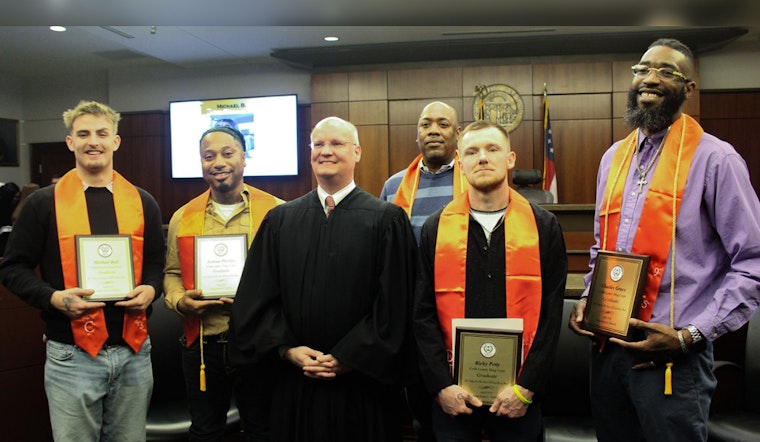
In a recent celebration, Cobb County Drug Treatment Court honored six graduates who successfully navigated through an extensive program aimed at overcoming substance use disorders. This ceremony, held at the Cobb Superior Court Ceremonial Courtroom, was not just about celebrating sobriety, but also recognizing the hard-won personal progress of each individual. Attended by judges, elected officials, community members, and supportive families and friends, the event underscored the community’s commitment to recovery and rehabilitation, according to a report by Cobb County Superior Court.
The Drug Treatment Court presents an alternative to traditional incarceration, offering a combination of judicial oversight, individualized treatment, and recovery support over a voluntary 18-to 24-month period. Struggling with substance use disorders, the graduates have worked hard to regain stability and take their places as productive citizens in the community. In a statement made by Cobb County Superior Court, one proud graduate expressed, "This program has been a major help for me—it changed my life just in time. The tools I’ve learned will take me places I never thought possible. It’s worth it, and it works if you truly want help and a better life. I’m forever grateful for this opportunity to get back on track and for the staff who supported me along the way. This isn’t the end—it’s just the beginning."
Another graduate detailed their journey from addiction to autonomy, telling Cobb County Superior Court, "Drug Court is the best thing that ever happened to me. Before this program, I had nothing. I was constantly chasing drugs and committing crimes. Now, I’ve been sober for 21 months, I have a car, I can maintain a steady job, and I have the tools to stay sober. I owe so much to the Drug Court team."
Superior Court Judge Jason D. Marbutt, who oversees the Drug Treatment Court, highlighted the program's significant role in the graduates' ability to adopt change. He was quoted in the Cobb County Superior Court's announcement saying, "Drug Treatment Court is a reminder that change is possible for those who choose it. We believe in our participants, and we remind them that although their journey is their own, they are not alone in it." Alongside the judge, Program Coordinator Porsha Winfrey recognized the deeper impact of the program on participants, stating, "Witnessing the transformation of our participants is nothing short of incredible. This program is more than an alternative to incarceration—it’s a second chance at life. Seeing individuals rebuild their futures, reconnect with loved ones, and achieve sobriety is priceless. Drug courts work, and our graduates are proof of that." In her statement, she powerfully marked the achievements of graduates who were once enmeshed in the justice system.





