

























































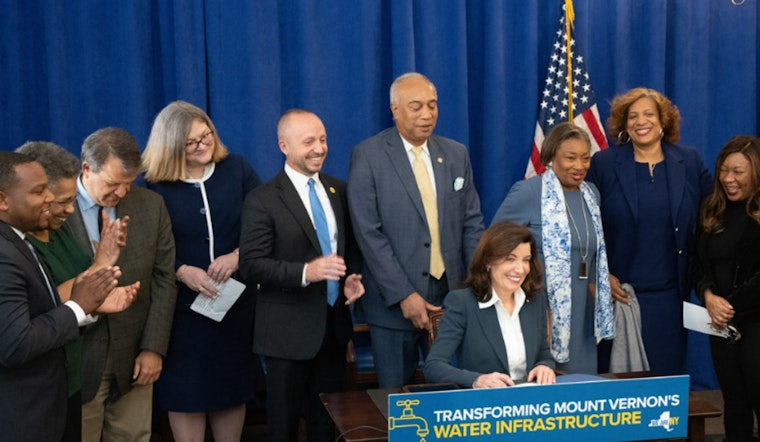
Marking a significant advancement in environmental equity, Governor Kathy Hochul joined Mount Vernon City officials to commemorate three years of progress on the city's water infrastructure overhaul. According to official statements, this marks a steady push forward in a $150 million state-backed mission to rejuvenate a once-neglected system. Key projects like the Third Street Sewer Project and the Healthy Homes Pilot Program have been completed, signaling a shift toward a more resilient Mount Vernon.
Westchester County Executive Ken Jenkins echoed the sentiment of progress, noting the importance of multi-level governmental collaboration in tackling the infrastructural deficits, "Today, we celebrate the significant progress being made towards water infrastructure challenges, and longstanding environmental justice concerns in Mount Vernon. The Third Street Sewer Project is a collaborative effort across many levels of government, that will ultimately lead to a more resilient and healthier community for our Westchester County residents living in Mount Vernon. We thank Governor Hochul for her leadership in revitalizing the aging and failing water infrastructure and look forward to working together towards the project’s completion,” Jenkins told officials, as noted by the Governor's official statement.
In a statement obtained by New York State's official website, Mayor Shawyn Patterson-Howard expressed deep gratitude for the state's unwavering support. The Healthy Homes initiative, with its recent completion of 24 households, takes a step further by equipping homes with necessary preventive measures against future environmental risks.
Work continues across the city, with efforts to address nearly 200 miles of storm and sanitary sewers. Environmental Facilities Corporation President and CEO Maureen A. Coleman emphasized that the transformative projects being celebrated are far more than just a patchwork of fixes. Her statement highlighted the bigger picture of these improvements, illustrating a city on the cusp of generational change. Details shared also pointed out that the Department of Health, alongside local water authorities, is actively identifying and planning to replace lead service lines.
Reinforcing New York’s position as a leader in water quality investment, the State allocated more than $2.2 billion in the 2024 Fiscal Year toward water infrastructure projects. An additional $500 million proposed in the FY26 Executive Budget further highlights the State’s commitment to tackling infrastructure challenges directly.



