

























































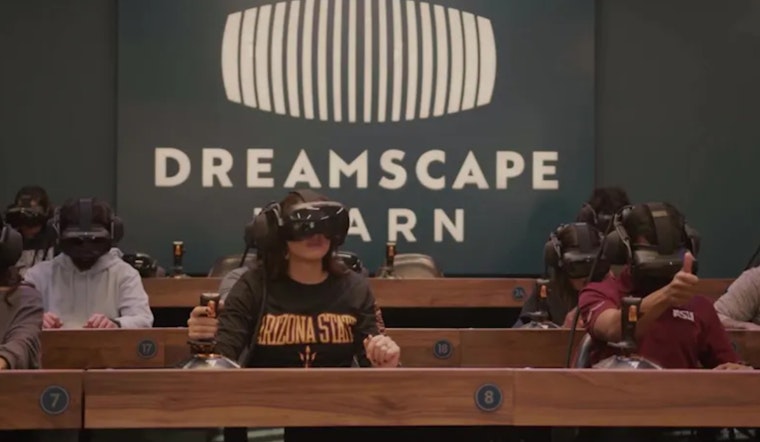
Arizona State University's decision to replace traditional introductory biology labs with virtual reality experiences is showing a spike in grades and retention among STEM majors. The virtual reality program, Dreamscape Learn, takes students on an immersive journey in a fictional 3-D intergalactic wildlife sanctuary, where they create field scientist avatars to collect data aimed at saving scores of near-extinct creatures. According to a report by Inside Higher Ed, research shows that since the program's inception in fall 2022, students are generally scoring higher not just in VR labs but also in advanced biology courses.
A study of around 4,000 students over two years revealed that VR biology labs likely contributed to an approximate quarter-grade improvement in students' final course marks. Michael Angilletta, an Associate Dean at ASU, said that this immersive learning environment is "so realistic when you're there and the story is so engrossing, they actually feel like the things that they're doing in VR are giving them hands-on skills." This emotional investment driven by storytelling is resonating with students, leading to stronger engagement and retention in STEM fields, a crucial factor, considering the high attrition rates, especially among low-income, female, and nonwhite students, as highlighted by FOX 10 Phoenix.
The Dreamscape Learn initiative can be seen as part of a broader movement in higher education to engage students beyond traditional methods, which are often predictive and mnemonic. As the world leans further into the age of generative artificial intelligence, the ability to think critically and adapt is becoming more imperative for a workforce in flux. Annie Hale, executive director of the EdPlus Action Lab at ASU, mentioned that through virtual reality storytelling, students must conduct quantitative analysis and reasoning, becoming fully engaged in the learning process; “It’s about jumping into an immersive environment and being fully engaged in a story,” she told FOX 10 Phoenix.
Despite the advances, implementing VR in education isn't without its financial challenges. Josh Reibel, CEO of Dreamscape Learn, acknowledged that the costs for setting up the immersive classrooms can range from mid-five figures to low six figures, depending on the school's size and scale of usage. Still, for ASU, this investment is already showing returns, as seen in their $5 million undertaking for virtual reality biology lab development. The introduction of VR in education is revealing its potential to democratize the learning process, allowing students from diverse backgrounds to envision themselves in scientific roles, as expert Jeremy Bailenson of Stanford University's Virtual Human Interaction Lab pointed out in comments to Inside Higher Ed.


