

























































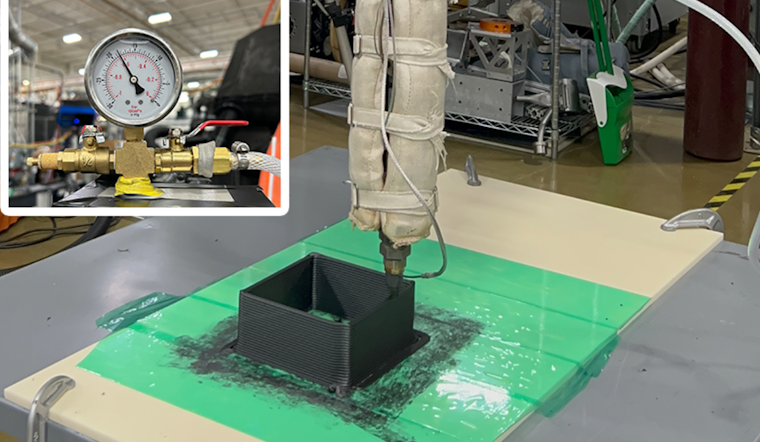
In a significant advancement for the 3D printing industry, scientists at Oak Ridge National Laboratory (ORNL) have debuted a new method that considerably enhances the strength of large-scale printed parts. According to a release from Oak Ridge National Laboratory, the procedure employs vacuum-assisted extrusion to cut down internal porosity by 75% in meter-sized polymer structures.
Dispelling the barriers to adoption in sectors such as aerospace and automotive, the novel approach involves integrating a vacuum hopper that removes trapped gases effectively, minimizing void formation in fiber-reinforced materials. These materials, crucial for large-format additive manufacturing (LFAM) due to their stiffness and minimal thermal expansion, traditionally suffered from porosity issues that compromised part quality.
The results of this technique are notably impactful, with reports of porosity being reduced to under 2%, propelling the integrity of the printed components to new heights. "Using this innovative technique, we are not only addressing the critical issue of porosity in large-scale polymer prints but also paving the way for stronger composites," ORNL’s Vipin Kumar stated, highlighting the broader implications for LFAM advancement, per the Oak Ridge National Laboratory.




