

























































Federal officials are reportedly considering reducing the size of six national monuments across the Southwest to open them for drilling and mining projects, with two Arizona sites directly in the crosshairs. The potential rollbacks would mark the second time in less than a decade that protected southwestern landscapes face boundary reductions to accommodate extractive industries.
According to The Washington Post, Interior Department officials are analyzing geological maps to assess mining and oil production potential at Baaj Nwaavjo I'tah Kukveni-Ancestral Footprints of the Grand Canyon National Monument and Ironwood Forest National Monument in Arizona. The review follows a secretarial order signed by Interior Secretary Doug Burgum directing staff to examine all "withdrawn public lands" for potential revision, as reported by ABC15.
Interior Secretary's Energy Dominance Vision
Doug Burgum, the 55th Secretary of the Interior, has made expanding domestic energy production a cornerstone of his tenure. The former North Dakota governor and tech entrepreneur took office in February 2025 with a mandate to implement President Trump's "energy dominance" agenda. According to the Interior Department, Burgum built Great Plains Software into a company with over 2,000 employees before its $1.1 billion acquisition by Microsoft.
During his confirmation hearing, Burgum stated that the Antiquities Act should only apply to small, "Indiana Jones-type archaeological" sites, suggesting a restrictive interpretation of the 1906 law that has protected iconic American landscapes. Bloomberg Law reports that his February 2025 secretarial order set a 15-day deadline for agencies to outline steps for revising national monuments to prioritize critical mineral development.
Arizona's Sacred Landscapes at Risk
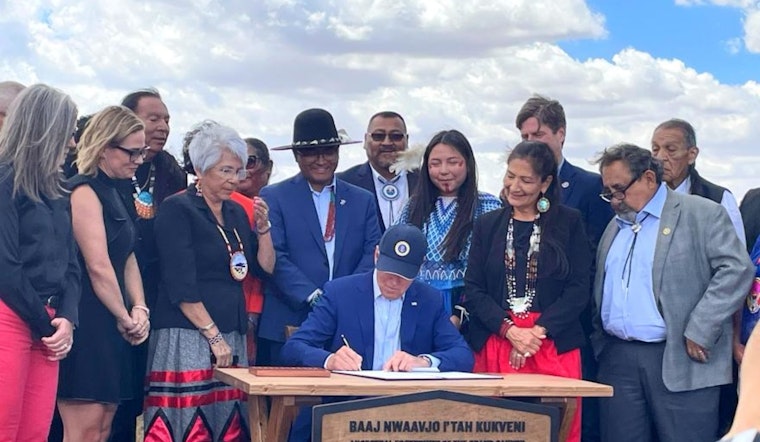
Baaj Nwaavjo I'tah Kukveni-Ancestral Footprints of the Grand Canyon National Monument represents the newest and largest protected area under consideration. President Biden established the 917,618-acre monument in August 2023 following years of advocacy by the Grand Canyon Tribal Coalition, representing 14 tribal nations. National Parks Traveler reports that the monument's name combines Havasupai and Hopi languages, meaning "where Indigenous peoples roam" and "our ancestral footprints."
The monument permanently protects watersheds feeding the Colorado River, which supplies water to 40 million Americans, while safeguarding thousands of sacred and cultural sites. Grand Canyon Trust notes that a December 2024 poll found 80% of Arizona voters support the monument, including 68% of Republicans. The designation prevents new uranium mining claims, though existing operations like the Pinyon Plain Mine near Tusayan continue under grandfathered rights.
Ironwood Forest National Monument, established by President Clinton in 2000, encompasses 129,055 acres northwest of Tucson. The monument protects some of the richest ironwood tree stands in the Sonoran Desert alongside more than 200 Hohokam archaeological sites dating back 5,000 years. The protected landscape supports desert bighorn sheep and serves as habitat for endangered species including the lesser long-nosed bat.
Historical Precedent and Legal Challenges
The current review echoes President Trump's first-term actions when he reduced Bears Ears National Monument in Utah by 85% and Grand Staircase-Escalante by nearly half in 2017. NPR reported that the reductions opened nearly one million acres to industrial uses including coal mining and oil drilling. President Biden restored full protections in 2021, but both Utah monuments appear on the current review list alongside four others across Arizona, California, and New Mexico.
Legal experts question presidential authority to unilaterally reduce existing monuments, noting that Earthjustice and conservation groups successfully challenged Trump's previous monument rollbacks in federal court. The lawsuits remain pending, creating uncertainty about the legal framework governing monument modifications. Constitutional scholars argue that while presidents can create monuments under the Antiquities Act, only Congress possesses clear authority to eliminate or substantially modify existing designations.
Mining Industry Interest
Private mining interests have actively lobbied for monument boundary changes, particularly around Ironwood Forest. Liberty Star Uranium & Metals Corp., led by CEO James Briscoe, has claimed the monument designation constitutes a "taking" of his company's mineral rights established through mining claims on federal land. The Arizona Daily Star reports that Briscoe estimates $80 billion worth of copper could be extracted from the Ironwood area, though environmental groups question these claims given the company's lack of published geological data.
The Tucson-based company has maintained mining claims within the monument boundaries, paying $4,030 annually in federal fees, but faces restrictions on exploration activities due to monument protections. In 2017, three Arizona Republican congressmen, including Rep. Paul Gosar, unsuccessfully pushed the first Trump administration to eliminate Ironwood Forest and other Arizona monuments entirely.
Regional Opposition and Economic Impact
Arizona's national monuments generate significant economic benefits through tourism, outdoor recreation, and scientific research. Tucson Sentinel reports that advocates emphasize these protected areas struggled to receive designations in the first place and represent irreplaceable natural and cultural resources. Friends of Ironwood Forest warns that mining would "devastate native ecosystems and sever wildlife connectivity" across critical habitat corridors.
Tribal leaders have expressed particular concern about potential uranium mining near the Grand Canyon, citing decades of health impacts on Navajo communities from previous extraction operations. The Center for Biological Diversity's Kieran Suckling announced plans to file lawsuits challenging any monument rollbacks, stating the group has already sued the Trump administration 23 times since January 2025.
The Arizona Faith Network and other religious organizations have joined conservation groups in opposing the monument review, arguing that protecting sacred Indigenous sites constitutes a moral obligation. Rev. Katie Sexton, executive director of the Arizona Faith Network, called potential boundary reductions "a sneaky, unpatriotic attack that strikes at the very foundation of the country's adored public lands."
Statewide Trends in Public Land Protection
Arizona hosts 18 national monuments, more than any other state, reflecting the region's exceptional geological, archaeological, and ecological diversity. The Wilderness Society notes that previous Trump administration reviews in 2017 targeted three Arizona monuments—Ironwood Forest, Vermilion Cliffs, and Sonoran Desert—for potential size reductions to accommodate increased mining and off-road vehicle access.
The current review occurs as Arizona faces increasing pressure to balance conservation with economic development amid growing population and industrial demands. However, polling by the Center for Western Priorities shows 65% of Utah voters and 80% of Arizona voters support maintaining current monument protections, suggesting potential political risks for monument reductions.
Legal Implications and Next Steps
Any monument boundary changes would trigger immediate litigation from tribal nations, conservation organizations, and potentially state governments. The legal landscape remains complex, as federal courts have not definitively ruled on presidential authority to modify existing monuments. The Supreme Court has indicated interest in addressing this constitutional question, though Chief Justice John Roberts noted in 2021 that determining appropriate monument sizes presents challenging legal precedents.
The Interior Department emphasized that no final decisions have been made and called the review process "pre-decisional." However, environmental law experts expect the administration to announce specific proposals by summer 2025, potentially setting up years of legal battles over America's protected landscapes. Congress retains ultimate authority to modify monument designations through legislation, though bipartisan support for such measures appears limited given polling data showing strong public support for conservation.



