

























































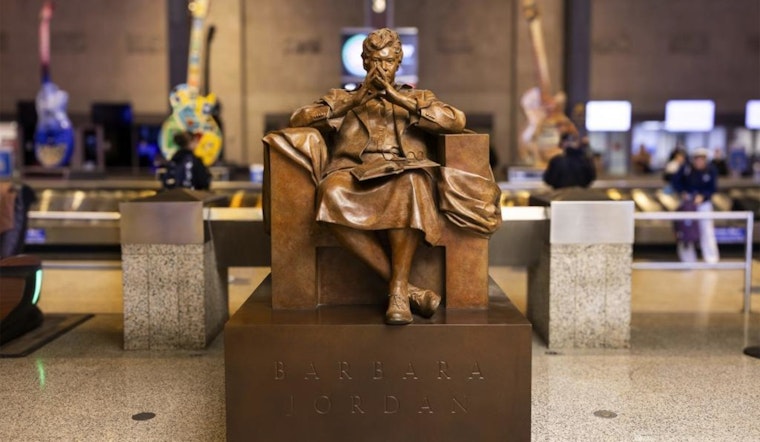
For those passing through Austin-Bergstrom International Airport, the name "Barbara Jordan Terminal" is hard to miss. But the story behind that name, as detailed in a recent City of Austin blog post, is one of a deeply impactful trailblazer whose heritage continues to shape Texas and beyond.
Barbara Jordan rose through the ranks of American politics, carving her path as the first Black woman elected to multiple legislative roles. In 1966, she made history by becoming the first Black woman ever elected to the Texas State Senate. She didn’t stop there, in 1972, Jordan also became the first Black woman from the South elected to the U.S. Congress and the first Black woman to preside over a legislative body as President Pro Tempore of the Texas State Senate.
Her oratory skills were as sharp as her pursuit of equality, bringing her national attention, especially during the Watergate Scandal. Jordan's keynote speech at the 1976 Democratic National Convention marked another first, as she was the first Black woman to handle such a significant role at a major party convention. Yet, her journey didn't end with speeches; Jordan continued to cultivate the next generation of leaders during her tenure as a professor at the LBJ School of Public Affairs at the University of Texas at Austin.
Her accolades are numerous, from induction into the Texas Women's Hall of Fame in 1984 to receiving the Presidential Medal of Freedom from President Clinton in 1994. Jordan's legacy extends to numerous honors, including the national Black Heritage stamp by the United States Postal Service in 2011. Recently, in 2022, the state showed its reverence by naming the Department of Insurance building after her, immortalizing her impact on the capital's landscape.
Now, in 2025, as construction moves forward with the Atrium Infill Project, visitors to the Barbara Jordan Terminal can explore her legacy through the Seated Heroic Sculpture of Congresswoman Barbara Jordan, which is surrounded by archival photographs and a timeline of her life. This installation ensures that while travelers transit through the heart of Austin, they are briefly immersed in the story of a woman whose belief in justice, democracy, and the power of voice continues to resonate.




