

























































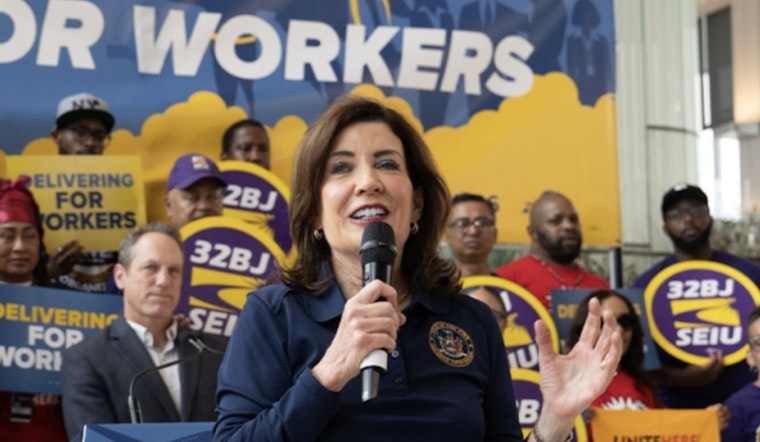
Thousands of airport workers at LaGuardia and JFK International airports celebrated a landmark victory this week as Governor Kathy Hochul announced sweeping enhancements to the Healthy Terminals Act that will provide expanded healthcare coverage, paid vacation time, and wage protections for previously excluded part-time employees. The governor rallied with union leaders and workers at LaGuardia Airport on Thursday afternoon to mark the culmination of years of organizing efforts by service workers who had been fighting for basic benefits and dignified working conditions.
Expanding Coverage to 15,000 Additional Workers
The enhanced legislation, which Governor Hochul signed in May as part of the Fiscal Year 2026 Enacted Budget, represents the most significant expansion of airport worker protections since the original act's passage in 2021. According to QNS, the amendments extend coverage to an additional 15,000 workers who were previously excluded from benefits, including ramp workers, cargo handlers, concessionaire employees, retail staff, and part-time workers across New York's major airports.
The expansion includes substantial improvements to paid time off policies, with workers now eligible for two to five weeks of paid vacation depending on their seniority, as well as an additional 10 paid holidays annually. Previously, as reported by QNS, employers were only required to provide seven days of state-mandated paid sick leave and just one paid holiday per year.
Building on Recent Wage Victories
The benefit enhancements build upon significant wage increases that airport workers secured in December following six months of rallies, job actions, and advocacy efforts. The Port Authority of New York and New Jersey approved raising the minimum wage for more than 10,000 airport workers subcontracted by airlines from $19 per hour to $25 per hour by January 2032, with workers seeing a $2.25 increase by the end of 2024.
This wage victory came after what The American Prospect described as one of the biggest private-sector unionization drives in years, with SEIU Local 32BJ successfully organizing more than 15,000 airport workers up and down the East Coast since 2010. The union's dual strategy of pursuing both living wage campaigns and unionization efforts has proven highly effective in transforming conditions for some of the lowest-paid workers in the aviation industry.
Personal Stories of Transformation
The new benefits represent life-changing improvements for workers who have long struggled with inadequate compensation and benefits. Cristiana Mendez, a cleaner at LaGuardia Airport who has worked there for over a decade, told the Governor's office that the changes are "a major victory" and noted, "Finally, we can enjoy the same services that we provide every day. Everyone needs time to travel, spend time with their families, and rest. For me, it'll make it easier to see my mom in Puerto Rico."
Pedro Gamboa Bermudez, a 68-year-old baggage handler at JFK, shared his personal struggle with QNS, explaining how the lack of paid vacation forced him to choose between paying bills and visiting his mother in Guatemala. "In the last decade of her life, I only got to see her twice," he said. "When she passed away last year, I had to wait until this year to hold a mass in her honor."
Historical Context and Legislative Evolution
The Healthy Terminals Act has evolved significantly since its original conception. Assembly Speaker Carl Heastie and Assemblymember Alicia Hyndman first championed the legislation in 2020, with the act dedicated to the memory of Leland Jordan, a baggage handler at JFK who fought for eight years for better working conditions before tragically dying from COVID-19 in April 2020.
The original act, which Seyfarth Shaw notes was passed after sitting in committee for over a year, established prevailing wage standards for covered airport workers and required employers to provide a $4.54 hourly supplement toward health insurance costs. However, the act initially excluded many categories of workers, particularly part-time employees who make up a significant portion of the airport workforce.
Union Organizing Success Model
The victory at LaGuardia reflects a broader organizing model that New Labor Forum has highlighted as an example of how unions can win in seemingly impossible circumstances. SEIU Local 32BJ, which represents 185,000 property service workers across twelve states and Washington D.C., has organized over 100,000 new members in the past two decades through strategic campaigns that leverage existing sources of power and build regional coalitions.
The union's airport organizing campaign, which began in New York in 2010, has achieved remarkable success by combining workplace organizing with political advocacy. SEIU reports that members working in New York and New Jersey airports as cleaners, baggage handlers, and security officers now earn $19 an hour—among the highest minimum wages in the country for these positions.
Broader Labor Trends and Context
The LaGuardia victory comes amid a broader national trend of wage growth for low-wage workers. Economic Policy Institute research shows that between 2019 and 2024, low-wage workers experienced historically fast real wage growth of 15.3%, representing a significant reversal of long-term inequality trends.
Airport worker organizing has gained momentum nationwide, with Metropolitan Washington Airports Authority implementing wage increases to $16.78 per hour as of January 2025, and Los Angeles proposing to raise wages for hotel and airport workers to $30 per hour by 2028 in preparation for the Olympics.
Political and Economic Impact
New York State Department of Labor Commissioner Roberta Reardon emphasized the economic significance of the legislation, stating that "JFK International and LaGuardia are high-volume gateways into New York State and are major hubs of economic activity." The airports handle over 90 million passengers annually, making them critical infrastructure that depends heavily on service workers.
State Senator Jessica Ramos noted that the expansion delivers "fair wages, vacation time, and long-denied protections to the essential workers who power our airports," while Assembly Labor Committee Chair Harry B. Bronson emphasized that airports are significant economic drivers that rely on essential service workers to operate effectively.
Implementation and Future Outlook
The enhanced Healthy Terminals Act provisions are scheduled to take effect in January 2026, with an exemption for small employers with ten or fewer employees. Gothamist reports that the changes apply specifically to part-time employees at JFK and LaGuardia airports and will extend benefits to food service workers, cleaners, baggage handlers, and other essential staff who were previously excluded.
Union leaders view this victory as part of a longer-term strategy to improve conditions for service workers across the region. SEIU 32BJ President Manny Pastreich told the Governor's office that the amendments represent "a testament to the union power they have built" and "will change thousands of lives and help ensure the health and safety of our state's airports."





