

























































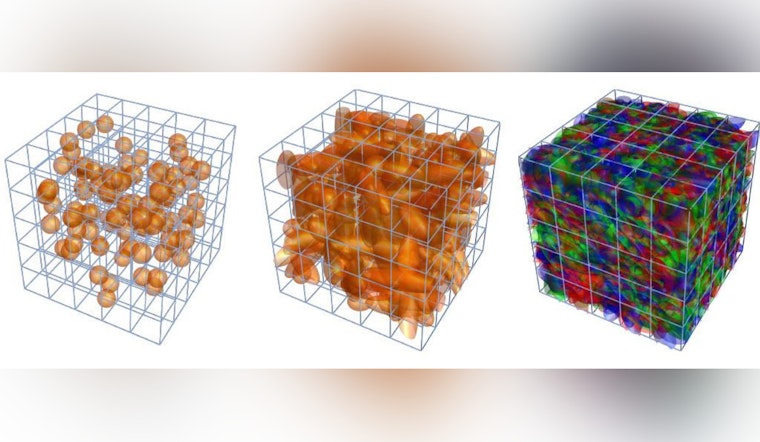
Researchers at the Massachusetts Institute of Technology have used the Frontier supercomputer to study the internal structure of neutron stars. The project focused on calculating density and pressure inside these stars using high-performance simulations. Frontier’s processing capacity enabled the team to model particle interactions that cannot be recreated in laboratory settings due to the extreme density of neutron star matter. According to the Oak Ridge National Laboratory, the simulation results may support future efforts to compare theoretical predictions with astronomical observations.
Scientists have mapped how pressure varies with isospin density in neutron stars, providing a detailed equation of state for this form of matter. Neutron stars, made mostly of neutrons, have high isospin density, unlike typical stars. Using the Frontier supercomputer, researchers calculated pressure values across the full range of this density. “For the first time, we have been able to map out how the pressure changes as you change this density. We now really have the equation of state mapped out across this entire density axis,” said William Detmold, lead investigator and Massachusetts Institute of Technology professor. The study also examined interactions between quarks and gluons, which are held together by the strong nuclear force. “It’s not a form of matter that we can create in laboratories and test, but it’s something we can try and make theoretical predictions about. And that’s really what my ultimate goal is — to understand from the underlying theory what that matter is like and what kind of observable consequences it will have for neutron stars,” Detmold said, as reported by the Oak Ridge National Laboratory.
Massachusetts Institute of Technology researchers have released new findings that give astrophysicists a clearer view of the internal structure of neutron stars. The study helps refine scientific models by reducing uncertainty around how matter behaves under extreme pressure and density. A major focus is whether quark matter—a state of matter made up of fundamental particles—exists at the core of these stars. "So, you’re going to have to make predictions for what happens if there is that matter, or if there isn’t, and confront them with experiment. There’s always going to be some kind of ambiguity, and it’s really a matter of how much you can push down on that ambiguity to really understand what’s going on at the fundamental level," said Detmold, as stated by the Oak Ridge National Laboratory.





