

























































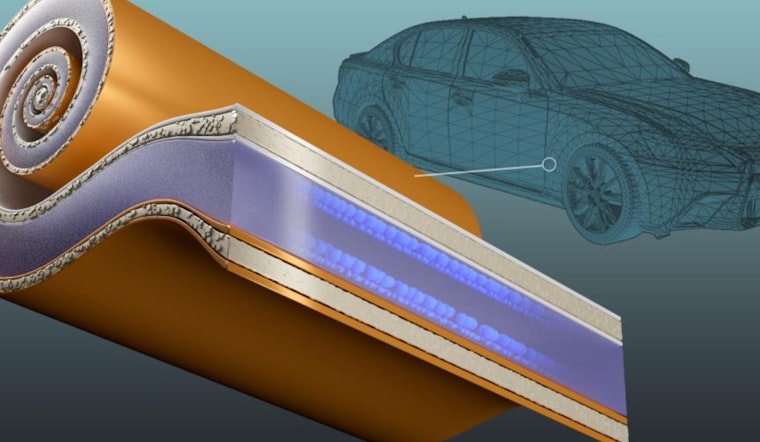
Electric vehicles (EVs) are set to get a significant boost in both affordability and fast-charging capabilities, thanks to a breakthrough from the Department of Energy's Oak Ridge National Laboratory. A newly developed battery component, a current collector designed by Soteria Battery Innovation Group, promises to cut costs and circumvent traditional supply chain issues, particularly the demand for copper.
Current collectors are critical to battery function, facilitating the flow of electricity from the battery's active material to its external circuit. Traditionally, these components are metal foils: copper at the anode and aluminum at the cathode. They are, however, heavy and contribute to the overall weight of an electric car. ORNL's innovation is a polymer-based current collector, thinner and lighter than conventional metal foil. It can allegedly reduce the weight of the current collector by about three-quarters, and "maintain significant energy density after a thousand cycles, even under extreme fast charging conditions," lead researcher Georgios Polyzos told Oak Ridge National Laboratory.
This new design not only trims the fat from EV batteries but also boasts the ability to recharge up to 80% of battery energy in a swift 10 minutes. Brian Morin, CEO of Soteria, confirmed in a statement obtained by Oak Ridge National Laboratory that despite the initial concerns related to the resistance of the plastic film, their tests show the battery can indeed handle a fast charge and discharge cycle. The cost savings come not just from less use of metal but from an 85% reduction in current collector costs overall.
Furthermore, the polymer film has a safety advantage. In the event of an internal short circuit, it acts as an internal circuit breaker, "which pulls the metal away" and therefore eliminates approximately 90% of lithium-ion battery fires caused by such faults, Morin explained. Soteria and ORNL have worked closely together to ensure that the novel metal-polymer current collectors can be incorporated into the standard roll-to-roll battery manufacturing process, essential for mass production and commercial scaling.





