

























































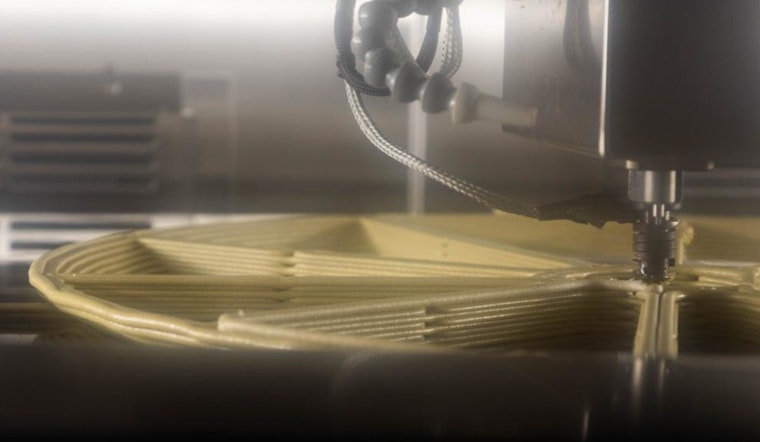
In a move to rapidly push the bounds of large-format 3D printing, the Department of Energy's Oak Ridge National Laboratory and JuggerBot 3D have linked up for a second round of research and development. This time, they're setting their sights on building systems capable of 3D printing with a broader palette that includes thermoset polymers—things like epoxies and polyurethanes—alongside thermoplastics. According to Oak Ridge National Laboratory, the collaboration under the Manufacturing Demonstration Facility (MDF) Technical Collaboration Program looks to leverage the successes of their previous project completed in February.
Their first venture yielded noteworthy enhancements to the uniformity and quality of thermoplastic 3D printing with pellet-fed technology. Before, designers were limited by the variations in the material bead width as it was deposited, which not only affected the finished product's aesthetics but its functionality as well. But by working together, JuggerBot 3D and ORNL have managed to largely crack this issue. "Creating innovative solutions with industry partners is what the MDF does best," MDF Director Ryan Dehoff told ORNL. The gains are clear: applications have expanded to include the likes of customized pipe fittings and fixtures for the oil and gas sector.
According to the ORNL, the process began with synchronizing ORNL's slicing software with JuggerBot 3D's printers. Slicing software translates 3D models into layers, directing the printing process with precision. JuggerBot 3D President and Co-founder Zachary DiVencenzo remarked on the importance of the collaboration: “When our company first transitioned to pellet-fed 3D printing, we faced a big risk because there were no available slicers that could do what we envisioned,” he explained in the announcement. “That is, until we met the ORNL team."
The partnership didn't stop at software. A key innovation was developing a way to dynamically calibrate the printers' material output, employing lasers to measure and adjust the bead width on the fly. This advancement translates to significant reductions in setup time. An operator can now simply select the machine they wish to use, slice the CAD design, and the system retrieves the necessary Material Card data to proceed autonomously. According to ORNL researcher Alex Roschli, "They won’t need to run the entire calibration process each time they change materials. This can save days or weeks."
In parallel, JuggerBot 3D secured a $4 million contract from the Air Force Research Laboratory to develop a system capable of processing both thermoset and thermoplastic materials. The project is expected to expand manufacturing capabilities within the MDF consortium—a network of manufacturers, end users, and academic institutions supported by the DOE’s Advanced Materials and Manufacturing Technologies Office, in collaboration with ORNL.





