

























































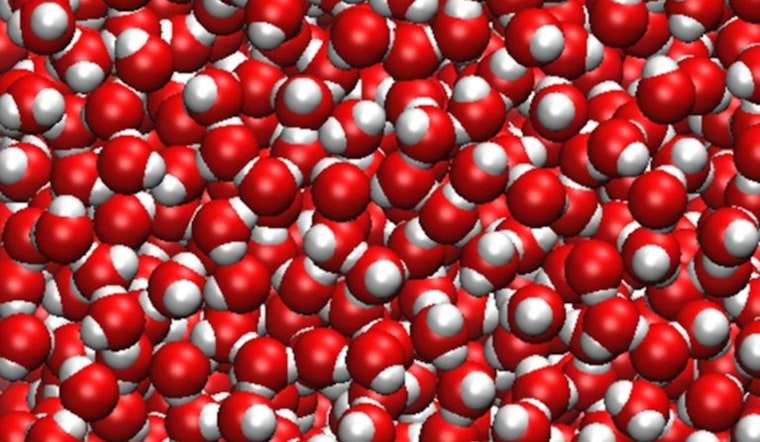
Computational scientists at the Department of Energy’s Oak Ridge National Laboratory (ORNL) have confirmed what could be a critical error in the standard methodologies used for molecular dynamics simulations involving water. A study published in the Journal of Chemical Theory and Computation over a year ago by the ORNL team initially pointed out that the commonly used 2 femtosecond time step might not be as accurate as once thought. Their latest research in the Royal Society of Chemistry’s journal Chemical Science has now reaffirmed that using standard time steps can indeed have a significantly greater impact on such simulations than previously anticipated.
"I was a little bit surprised. I was hoping for much more subdued effects, but the errors can be big," Dilip Asthagiri, a senior computational biomedical scientist at ORNL's Advanced Computing for Life Sciences and Engineering group, told the publication. Asthagiri emphasized the importance of executing statistical mechanics with the highest degree of accuracy to better assess and address errors in simulation.
Accurate water simulations are key across various industries, from pharmaceuticals to petroleum, as they play a crucial role in research and development. Prior findings by the team demonstrated that stepping beyond a 0.5 femtosecond interval could lead to errors, violating the principle of equipartition that requires equal average kinetic energy for all types of motion within simulations.
In their recent study, the ORNL researchers utilized the Frontier supercomputer to simulate liquid water samples, analyzing their volume and density under different conditions. Asthagiri explained, "What our study shows is, using the same pressure, doing the simulation at longer time steps will give you different volumes or give you alternatively different densities. But if you go to very short time steps, the results all converge, and you get a consistent prediction." The team also investigated hydration’s role in protein folding thermodynamics, an area sensitive to such volumetric inaccuracies, which could have far-reaching implications in biology and medicine.
Despite initial skepticism from some peers, the first study's results were significant enough to be cited in several scientific publications. This latest research iteration underscores the need for more careful simulation methodologies when handling the complex interactions of water at a molecular level. The insights gathered from this work underscore a broader ambition to enhance simulations for larger biological systems, which the ORNL team views as imperative to understanding and designing medical treatments. ORNL is managed by UT-Battelle for the DOE’s Office of Science, the leading entity for physical sciences research in the United States, and it hosts the Frontier supercomputer at the OLCF, a user facility for the DOE Office of Science.





