

























































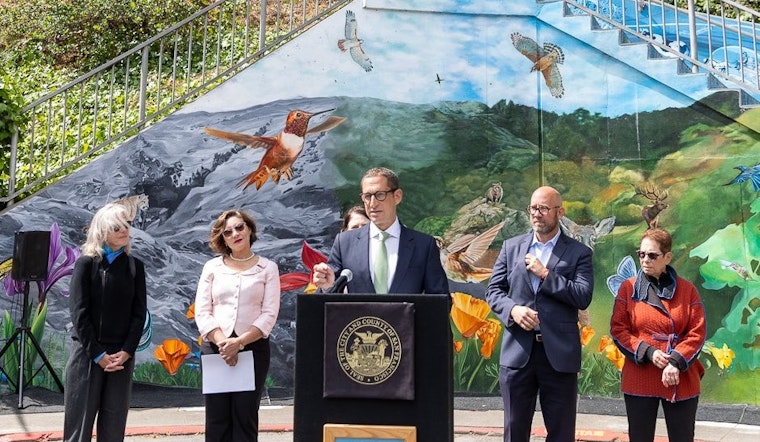
Sometimes the smallest acts of rebellion spark the biggest changes. When Susan and Joe Meyers faced a $1,400 fine for their beloved Little Free Library on Pine Street—a community treasure that had been sharing books for over a decade—they could have quietly paid up and moved on. Instead, they dug in their heels and helped reshape how San Francisco thinks about neighborhood beautification.
Now, under Mayor Daniel Lurie's revitalized "Love Our Neighborhoods" permit program, residents across the city can install benches, murals, and book-sharing boxes without navigating the bureaucratic maze that once threatened to turn community spirit into municipal citations. It's a remarkable turnaround that shows how citizen advocacy can actually work—even in a city famous for its red tape.
The Little Library That Could
The Meyers saga reads like a perfect San Francisco story: well-meaning residents, bureaucratic overreach, and a happy ending that required community organizing. According to the San Francisco Chronicle, their Pine Street Little Free Library had been a neighborhood gathering spot for years before a single complaint triggered a Department of Public Works citation for sidewalk encroachment.
Rather than fork over the cash, the couple channeled their frustration into advocacy, working with city supervisors to create what became the Love Our Neighborhoods ordinance. Little Free Library reports that their eventual celebration party at the very location that sparked the controversy became a symbol of grassroots persistence paying off.
"We want to encourage anybody who wants to have a Little Free Library, because it brings a whole community together," Susan Meyers told the Chronicle. "We have a clump of people who commune around our house every day."
Three Tiers of Neighborhood Love
The current program takes a surprisingly sensible approach to community improvements—imagine that. According to San Francisco's Public Works Code, projects are now sorted into three tiers based on complexity, not city departments' whims.
Tier 1 covers the basics: sidewalk libraries, planter boxes, and front yard benches that can be installed through simple self-certification. Tier 2 includes murals and decorative string lighting—because apparently, someone once decided those needed extensive review. Tier 3 tackles the bigger stuff like sculptures and major stairway construction, which actually makes sense to review carefully.
San Francisco Public Works dedicated real resources to make this work, allocating $223,574 for fiscal year 2024 and $368,252 for fiscal year 2025 to hire an administrative analyst and a street inspector specifically for the program. That's putting money where municipal mouth is.
Lurie's Bigger Permit Puzzle
The Love Our Neighborhoods program operates as part of Mayor Lurie's broader PermitSF initiative—his administration's attempt to drag San Francisco's permitting process into the 21st century. According to the City and County of San Francisco, the goal is making the system "customer-focused, faster, and more transparent," which sounds revolutionary only because the bar was set remarkably low.
Not everyone's buying in completely, though. The San Francisco Chronicle reports that North Beach and portions of the Mission District successfully lobbied to opt out of certain business permitting reforms, arguing their neighborhoods' "fragile cultural makeup" needs protection from streamlined processes. It's a fascinating tension between efficiency and preservation that reflects broader citywide debates about change.
The Man Behind the Reforms
Mayor Lurie brings an interesting background to these efforts—he's the heir to the Levi Strauss fortune who spent years running Tipping Point Community, a Bay Area anti-poverty nonprofit. His approach seems to blend philanthropic thinking with political pragmatism, and Mission Local notes he's managed to earn "near-unanimous approval" from the Board of Supervisors for major initiatives—no small feat in San Francisco politics.
His team includes some heavy hitters, like former Twitter CFO Ned Segal as Chief of Housing and Economic Development, working alongside Planning Department Director Rich Hillis to coordinate reform efforts across multiple agencies. It's the kind of private-sector-meets-public-service approach that either works brilliantly or crashes spectacularly—so far, it seems to be working.
Community Response and Broader Trends
CBS San Francisco reports that residents are embracing the streamlined processes, taking advantage of "Love Our City" beautification days and simplified approval processes for smaller projects. Rachel Gordon from Public Works struck a pragmatic tone: "We want people to work with us, though, not get frustrated as we're trying to make sure that things are kept safe."
The program reflects broader municipal trends toward permit modernization, as cities across California grapple with housing costs and bureaucratic delays that discourage community investment. According to SF Planning, successful permit reform typically balances community engagement with necessary oversight—easier said than done, but San Francisco seems to be finding a workable middle ground.
The Permit Center Evolution
The practical changes are happening at 49 South Van Ness Avenue, where the city's Permit Center has extended hours and developed online tracking systems. According to the mayor's office, these improvements aim to save residents and small businesses "thousands of dollars and months of time"—claims that would be impressive if they pan out in practice.
The broader context matters here: San Francisco faces significant budget pressures while trying to encourage community investment that supplements city resources. Effective permit reform could help leverage residents' willingness to improve their neighborhoods without requiring massive municipal spending. Whether that theory holds up remains to be seen, but the early signs suggest people are ready to engage when the barriers come down.
From Pine Street's Little Free Library to citywide permit reform, the Love Our Neighborhoods program represents something surprisingly rare in municipal government: a policy that started with genuine community needs and evolved into systematic change. Sometimes the smallest rebellions really do spark the biggest transformations.





