

























































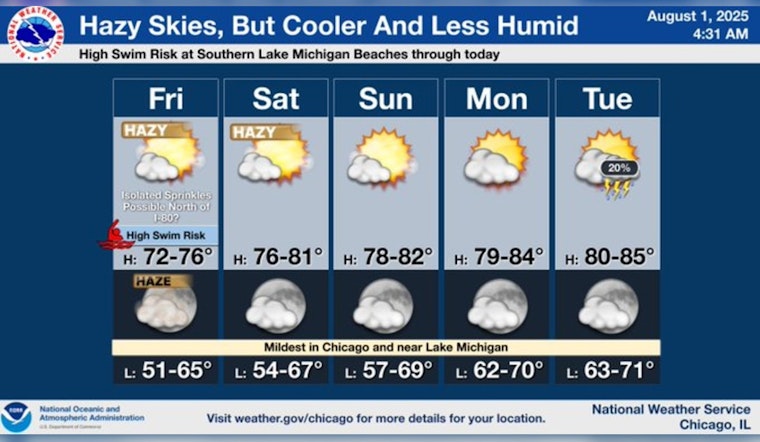
As Chicago grapples with an ongoing air quality alert, health concerns rise amid persistent smoke from the Canadian wildfires. The National Weather Service (NWS) predicts areas of smoke before 10 am today, with mostly sunny skies and a high near 74. Despite the warm conditions, which are favorable for outdoor activities, the advisory cautions residents to limit their time outside due to the "unhealthy" air conditions, particularly affecting older adults, young children, and those with respiratory problems. A forecast from the NWS details widespread haze before 1am tonight, followed by a partly cloudy low around 64.
IQAir's ranking of Chicago reinforced the unhealthy air quality as having the "worst air quality in the world" just a day earlier. Measurements early this Friday morning indicated a PM 2.5 level of 157, which is firmly in the category considered hazardous, compelling residents to urgently reassess their outdoor plans. The NWS out of Lincoln, Illinois, suggested closing windows to avoid smoke intrusion, stating, "If you were wanting to sleep with the windows open to enjoy the cooler weather, we regret to say the smoke has different plans," in a report acquired by NBC Chicago.
Residents seeking information on the Air Quality Index (AQI) can utilize AirNow's tool to search their ZIP code for real-time and forecasted air quality levels. The AQI is a color-coded system used by the Environmental Protection Agency to communicate air quality levels and their potential impact on health.
Exacerbating the situation is the “sinking air” of high pressure, which, according to NBC 5 Storm Team Meteorologist Alicia Roman, is keeping the smoke "locked-in at the surface." She explained, "That's why we had some of the worst air quality in the world yesterday," and further indicated that a change in wind pattern is required to "to truly knock that smoke out." The haze is expected to linger into Saturday but should improve gradually. The weekend promises sunny conditions, peaking at 81 degrees on Sunday.
The presence of PM2.5, fine inhalable particles, is a primary concern for environmental and health officials. With diameters generally 2.5 micrometers and smaller, these particles are a fraction of a human hair's width and comprise one of five major air pollutants regulated by the Clean Air Act. Ahead of improvements, Chicagoans are advised to remain vigilant and stay informed on air quality changes to maintain their health and safety.





