

























































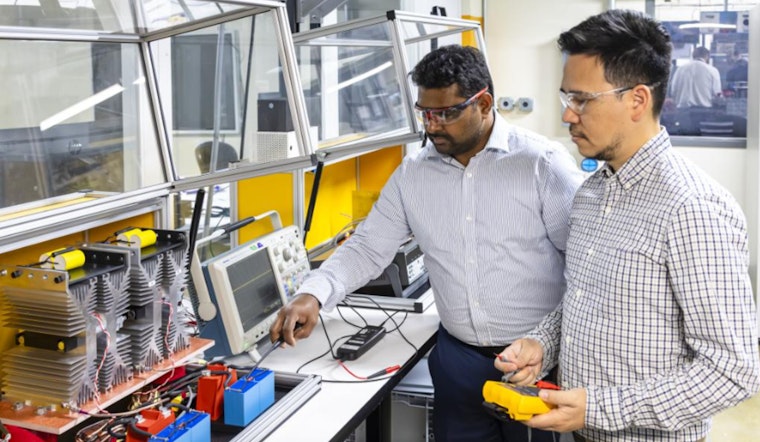
Oak Ridge National Laboratory, a Department of Energy facility, has developed medium-voltage circuit breakers that can handle direct current more effectively and at lower cost. Led by Prasad Kandula and the Grid Systems Hardware group, the Oak Ridge National Laboratory team created semiconductor-based breakers that work about 100 times faster than traditional mechanical switches, addressing the challenge of managing DC power safely. “Developing this technology helps keep the grid working safely and reliably while keeping more energy available to support our growing population and economy,” Kandula said, according to the Oak Ridge National Laboratory.
DC power is becoming more important in energy-intensive sectors such as AI data centers because it flows with less resistance through power lines, losing less energy in transit and avoiding waste from converting between DC-based electronics and an AC grid. Traditional mechanical breakers have limits since DC "is capable of sparking across a gap in an arc of explosive energy," while semiconductor-based devices offer a safer solution. Engineers at Oak Ridge National Laboratory developed a prototype using thyristors, which are more affordable than earlier semiconductor options. “We selected a base technology that was robust, efficient and inexpensive,” said Kandula. The prototype can interrupt currents at 1,400 volts in under 50 microseconds.
Oak Ridge National Laboratory, supported by the DOE Office of Electricity, is developing advanced circuit breakers for modern and future DC grids. Researchers, including Marcio Kimpara and Elvey Andrade, are working to scale the technology to handle up to 10,000 volts by connecting breakers in series without reducing reaction speed. The project aims to create medium-voltage building blocks for wider power applications across the U.S. economy.




