

























































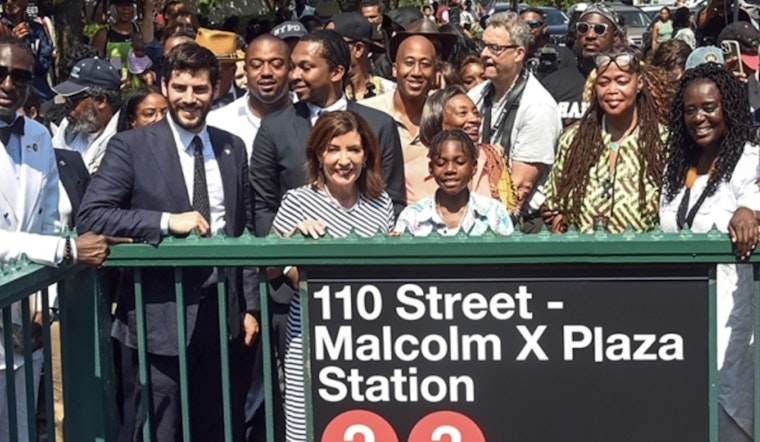
During Harlem Week, Governor Kathy Hochul signed legislation establishing the Harlem Renaissance Cultural District. The district, which extends from 110th Street to 155th Street and from Fifth Avenue to the Hudson River, formally recognizes the area's historical contributions to art, music, and culture.
The ceremony included both celebration and remembrance, as Governor Hochul honored the late Lloyd Williams, co-founder of Harlem Week, in the presence of community leaders and residents. Additionally, the governor announced the renaming of the 110th Street-Central Park North subway station to 110th Street – Malcolm X Plaza Station, recognizing the legacy of the civil rights leader, according to the Governor's office.
Governor Hochul was joined by State Senator Cordell Cleare and Assemblymember Jordan Wright, the legislators responsible for the successful bills. Cleare's efforts played a key role in passing the legislation, which recognizes both the physical space and New York’s ongoing pursuit of racial equality. Also in attendance were the mayor, MTA leaders, and members of Malcolm X’s family.
The signing event went beyond formalizing a cultural district by focusing on the stories of influential Harlemites. Ilyasah Shabazz, Malcolm X's daughter, provided a personal account of her father's legacy, addressing both the pain of his absence and his impact. During her remarks, Governor Hochul responded to Shabazz’s request for transparency, stating, "Now, if the family wants the files released, I say, release the files." This statement reflected a call for clarity and acknowledgment of past grievances and was made during Shabazz’s unscripted comments directed at the Department of Justice, in a statement obtained by the Governor's office.
Signing ceremony proceedings also included Kayden Hern, a young poet laureate first introduced by Governor Hochul prior to her election. Hern recited a poem on the steps of the Apollo Theater and was formally acknowledged for his participation. Legislative actions and commemorative events were held to mark the recognition of Harlem’s cultural history, with government involvement recorded as part of the process to document and preserve the community’s legacy.





