

























































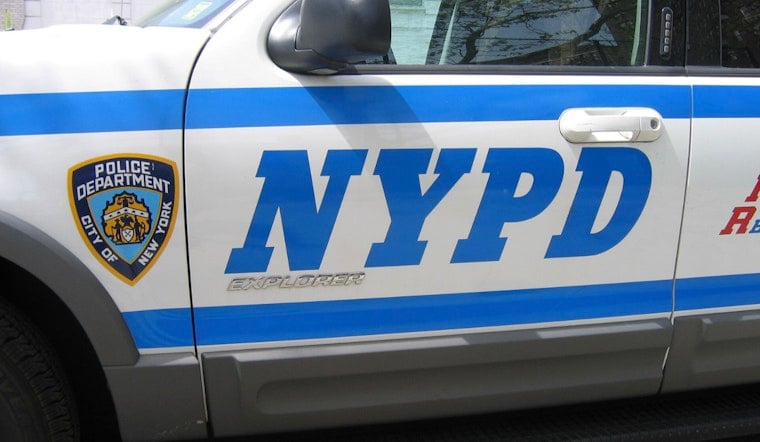
NYPD officers shot a man in front of 126 Ludlow St. on Manhattan's Lower East Side Sunday afternoon, leaving him critically injured and sending four officers to the hospital with minor injuries. Police say the confrontation unfolded after they responded to a 911 call about a man armed with a weapon near Ludlow Street and Rivington Street, and that the man had allegedly stabbed someone before charging at officers, who then opened fire.
According to New York Daily News, the incident happened around 4:30 p.m. Sunday, and police gunfire struck the suspect at least one time. Police described him as being in critical condition, and early reports that he stabbed someone and then charged at officers with a weapon remain under investigation, the outlet noted. As reported by CBS News, the shooting occurred shortly after 4 p.m. and left two people transported to Bellevue Hospital, while four NYPD officers were treated for minor injuries at NewYork-Presbyterian.
NYPD asked people to avoid the vicinity of Rivington and Ludlow streets due to the ongoing police activity, per the Daily News report. Police Commissioner Jessica Tisch personally oversaw the department's initial response and public communication following the Sunday afternoon shooting, CBS News reported.
A Precinct Built for Density, Not Distance
The 7th Precinct, which responded from its station house at 19 1/2 Pitt Street, covers just 0.62 square miles of the Lower East Side, making it the second smallest police precinct by land area in New York City, according to NYC.gov. That compact footprint packs together public housing, historic tenements, and busy commercial corridors, a mix that has repeatedly put the precinct in the middle of high-profile violent incidents. The building where Sunday's shooting occurred, 126 Ludlow St., is historically known as the Esther Apartments, constructed in 1930 with lettering reflecting the neighborhood's early 20th-century Jewish immigrant history, per a local historical account shared on Facebook.
Any police firearm discharge during an adversarial encounter triggers an immediate inquiry by the NYPD's Force Investigation Division, which secures body-worn camera footage, inspects involved weapons, and interviews witness officers, according to reporting on the unit's procedures cited by the New York Attorney General's office. The division was created in 2015 to centralize what had previously been ad-hoc borough shooting teams.
State Oversight Could Follow if Condition Worsens
Under New York Executive Law § 70-b, the state Attorney General's Office of Special Investigation automatically assesses reported police encounters to determine whether a state-level criminal investigation is required whenever officer conduct may have caused or contributed to a civilian fatality, per the same Attorney General's office citation. That review is triggered specifically in fatal cases, and it remains unclear whether the man shot Sunday will survive his injuries; police described him only as thought to be in critical condition.
Any use of force by officers will also be measured against New York Penal Law § 35.30, which permits deadly physical force only when officers objectively and subjectively reasonably believe it necessary to defend themselves or others from imminent deadly physical force, according to the New York State Senate. That standard requires both a genuine belief in the threat and a reasonable basis for it under the totality of the circumstances.
Another Violent Incident on the Same Corridor
Sunday's shooting comes just ten days after a 25-year-old bodega employee was shot in the back during an attempted theft at a convenience store on nearby Rivington Street, a case Hoodline covered in its report on the botched robbery. Advocacy groups offered a $5,000 reward following that earlier shooting, according to the Citizen app. The back-to-back incidents on the same stretch of the Lower East Side have kept public safety concerns front and center for residents and business owners in the neighborhood.
Despite the recent violence, NYPD data show that annual police firearms discharge incidents citywide have declined substantially since recordkeeping began in 1971, moving from hundreds of adversarial shootings a year in the 1970s to historically lower figures more recently, according to NYC.gov's use-of-force reporting. Investigators have not yet released additional details on the identity of the man shot Sunday, the condition of the person he allegedly stabbed, or the specific weapon involved, leaving several key questions unresolved as the Force Investigation Division's review continues.




