

























































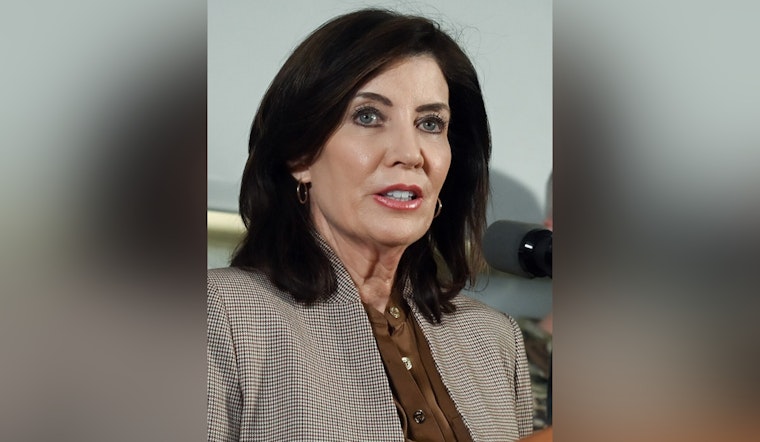
In a political landscape increasingly marred by maneuvers to gain partisan advantage, New York Governor Kathy Hochul has shed her cautious exterior for a combative stance on redistricting. Hochul, previously recognized as a centrist, now vociferously counters Republican redistricting strategies, fervent in her resolve to not fight "these battles with my hands tied behind my back" due to New York's Independent Redistricting Commission. Fordham University political science professor Christina Greer, analyzing the governor's shift, notes the eagerness among Democrats for leaders who approach the fight with more than rhetoric, indicating a strategic pivot from Hochul ahead of her reelection bid. However, Republicans criticize her outspokenness as indicative of Democratic hypocrisy, never shy to claim the moral high ground, as reported by Gothamist.
While some may hope this shift indicates a larger trend of dedication to the political fight for democracy, good government groups aren't having any of. In fact, they quickly fired back after Hochul's assertion that "politics is a political process," as per a Spectrum News 1 report. Groups like Reinvent Albany and NYPIRG insist that tit-for-tat strategies in redistricting betray the foundational democratic ideal of "one person, one vote." The groups maintain that an independent process, untainted by partisan interests, is essential and firing back at states like Texas counter their efforts. Rachael Fauss of Reinvent Albany and NYPIRG's Blair Horner both express concerns, with Horner especially highlighting the inherent danger of to the public interest when political parties prioritize their own advantage.
Yet, the question of how fairness can be maintained in this charged environment remains contentious. Deputy Senate Majority Leader Mike Gianaris, a key figure in crafting the redistricting amendment under discussion in Albany, argues that not responding to moves in states like Texas would be neglectful. Gianaris's view is that redistricting principles laid out in the Constitution cannot be ignored, yet New York must act to prevent the distortion of the national political landscape. His position underscores a prevailing tension between upholding standards of fair representation and the practical need to counter partisan schemes. Meanwhile, Ken Jenkins, chairman of the Independent Redistricting Commission, has not commented on the controversy.
This debate over how to balance the scales of political power comes at a time when New York cannot alter its congressional district lines until at least 2027 due to the state's constitutional requirements. Those advocating for a comprehensive redistricting reform, like NYPIRG and Reinvent Albany, argue that there is ample time to construct a system that ensures equitable representation without resorting to partisan tactics. "An eye for an eye leaves the world blind," says Horner, pointing to the need for a renewed focus on independence within the redistricting process. This sentiment echoes a broader public frustration with how partisan edges are commonly honed at the expense of the electorate's trust and the equitable function of democracy, Spectrum News 1 reported.





