

























































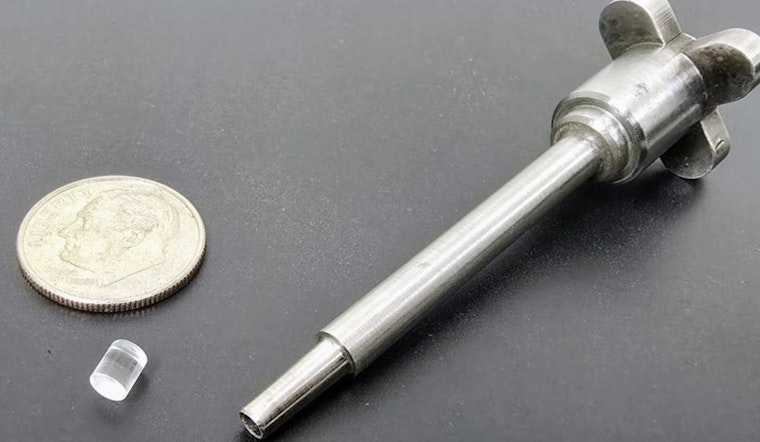
Scientists and engineers at Oak Ridge National Laboratory (ORNL) have played a significant role in advancing the frontier of fusion energy. A testament to this contribution is the role ORNL's pellet injector system had in the recent achievement by the Wendelstein 7-X stellarator, which now appears to hold the world record for maintaining a high "triple product" in a plasma state, a measure crucial to sustaining nuclear fusion. As reported by ORNL, the W7-X in Greifswald, Germany, managed to maintain a plasma with a record high triple product for an impressive 43 seconds.
The W7-X, renowned for its brief but intense fusion performance, struggled with sustaining high plasma density over time. "The W7-X device had previously achieved high performance for short durations, but they couldn’t sustain it at high plasma density," ORNL engineer Steve Meitner said in a statement obtained by ORNL. The pellet injector revolutionized this by feeding a continuous stream of superchilled hydrogen directly into the inferno of the 30-million-degree plasma, shoring up the plasma density - a particularly significant factor in the stellarator design.
Working in concert with the Max Planck Institute for Plasma Physics, the Princeton Plasma Physics Laboratory, and the National Institute for Fusion Science in Japan, ORNL's contribution has substantially advanced stable plasma containment. The uniqueness of stellarators lies in their intricate magnetic designs, which are believed to offer superior confinement properties but come with the complexity of requiring precise fueling techniques to optimize performance.
This recent breakthrough could represent a significant stride towards practical fusion power, a holy grail of endless clean energy that scientists and engineers have pursued for decades. The pellet injector plays a critical role, as it bypasses the limitations of traditional fueling methods that struggle to supply sufficient fuel to maintain a high-density plasma. With the injector, the W7-X can achieve, and more importantly, sustain the conditions necessary for a longer duration —a key requirement for the viability of fusion energy on a commercial scale.
While many still deem commercial fusion power to be an elusive dream, achievements like the one by the W7-X team underscore the incremental yet indelible progress being made. It’s a collaborative effort at the edge of scientific understanding, where meticulous engineering meets the grand challenge of recreating a piece of the sun's power here on Earth.





