

























































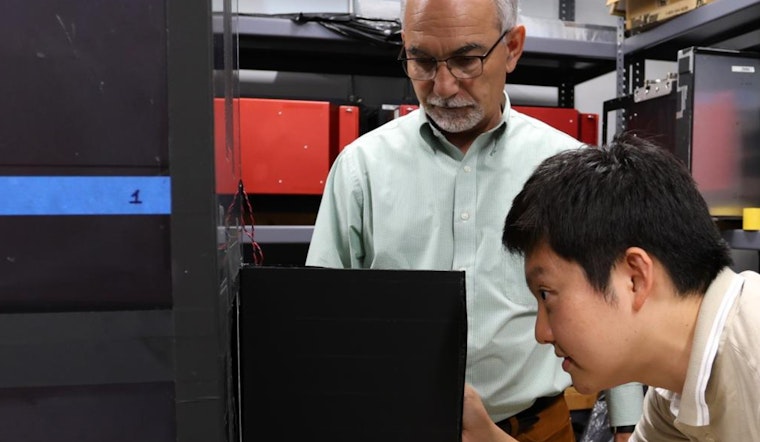
Oak Ridge National Laboratory has unveiled a high-tech muon detector, described as a significant achievement in monitoring nuclear materials and advancing quantum computing. As per information released by ORNL, physicists and engineers collaborated to develop this mobile detector, leveraging muons—which, much like their more familiar counterpart the neutron, are a type of subatomic particle—to penetrate deep into matter without degrading the sample. The detector, rooted in technology initially designed for neutron detection, represents a major interdisciplinary effort at the laboratory.
Despite muons decay rapidly in just a couple of microseconds, much faster than the 10-minute half-life of neutrons, the team's work allows these particles to be harnessed for closer inspection of dense materials. ORNL's JungHyun Bae, recognized in the American Nuclear Society’s 40 Under 40 list in late 2024, led the projects for muon tomography, an area that challenges researchers due to the fleeting existence of muons. "We are thrilled to have brought this vision to life," Bae told ORNL. This technological breakthrough is expected to aid in the handling of nuclear waste and contribute to quantum computing by managing errors that cosmic radiation causes in qubits, the fundamental units of quantum information.
The unique dual-measurement capability of ORNL's muon detector—a feature that marks improvement over previous tomography systems—will offer scientists detailed images of samples, including hazardous materials. As pointed out by Dr. Polad Shikhaliev, the senior detector scientist and lead developer, "Collaborative work is essential in scientific research," and "At ORNL, we have a wealth of expertise, and the willingness to work together is what made this project a success," as reported by ORNL. The detector will now be transitioned to its designated facility at ORNL for operational use.
The project started with a Eureka moment when Bae, reflecting on his doctoral research, stumbled upon the design he needed at a museum exhibit. After a crucial partnership formed with Yacouba Diawara's team, who had previously worked on the neutron detector for the Spallation Neutron Source, progress accelerated. Designed more than ten years ago, the neutron detector's framework provided a solid foundation for the muon detector's innovation. "The return on investment for that original detector has well exceeded our expectations," said Diawara, revealing the converter of technologies that were drawn from the realms of neutron detection to muon tomography, according to a statement by ORNL.





