

























































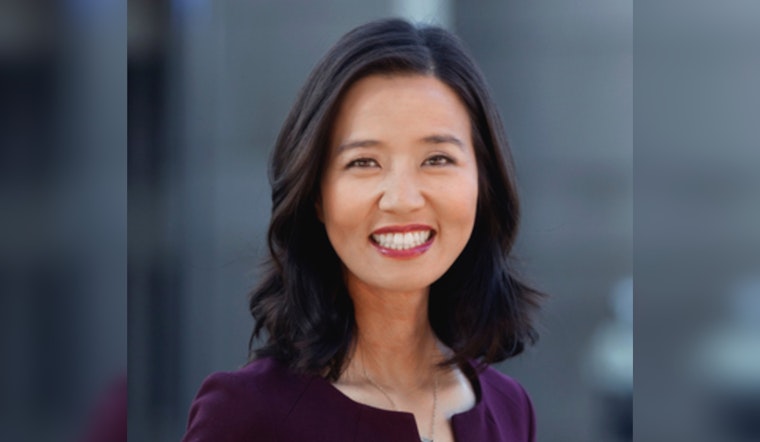
Boston Mayor Michelle Wu has unveiled the recipients of the 2025 Community Clean Air Grant, in a move to curb air pollution and promote public health, particularly in neighborhoods most susceptible to environmental deficits. As reported on the city's official website, a hefty sum of $1,117,296 will be doled out to fund six community-oriented ventures over the ensuing two years. These initiatives aim to significantly diminish air pollution levels in areas that have historically been marginalized when it comes to environmental cleanliness.
Among the chosen are diverse groups with inventive strategies to tackle the ever-looming threat of airborne contaminants. The Allston-Brighton Health Collaborative will receive $199,985 "to deploy sensors and air purifiers to measure and mitigate traffic-related air pollution from the Massachusetts Turnpike and to develop air quality education materials," as outlined in the announcement. Chinatown Main Street is slated to launch a youth-driven air quality educational campaign and kickstart a microgrant program, enhancing indoor air quality for local restaurants and small businesses, backed by a grant of $159,230.
Addressing the technological component, Olin College of Engineering, in collaboration with the Fairmount Indigo CDC Collaborative, will put to use $179,340 to measure public transit-linked air pollution and roll out educational materials about their findings. Boston University is teaming up with Boston Public Schools, utilizing a $194,691 grant to develop an air pollution monitoring and action strategy to lower exposure among students and staff. "We’re excited to partner with Boston Public Schools to co-develop an Air Pollution Action Plan that brings together the school community, Boston University researchers, and real-time data from the district’s groundbreaking air quality sensor network," stated M. Patricia Fabian on the City of Boston, a prominent voice from Boston University, speaking in regard to the allocated funds.
The Community Clean Air Grant initiative is financially bolstered by the Air Pollution Control Commission’s Pollution Abatement Fund. It is an embodiment of Boston’s effort to nurture a healthier, more sustainable urban ecosystem, with clean air as a pivotal component. GreenRoots is granted $200,000 to push forward with precise air quality monitoring, where John Walkey, a Director at the organization, expressed excitement on the City of Boston: "to monitor ultrafine particulate matter in a way that we have never done before." The essential nature of this mission is further underlined by the Neighborhood of Affordable Housing, which will expand their project using a $184,050 grant to provide material assistance and educational workshops to communities in distress.
These grants are not merely financial transfers; they represent a tangible commitment to progress. Debbie Ho, Executive Director at Chinatown Main Street, acknowledged their project's potential impact on the City of Boston: "To combat the highest air pollution levels in the Commonwealth, the Chinatown CLEAN project will focus on empowering local small businesses." This focus on empowering locals pervades the program, with subsequent funding opportunities set to open in summer 2026, inviting prospective applicants to brainstorm initiatives that could engineer a future with cleaner air for all Bostonians.


