

























































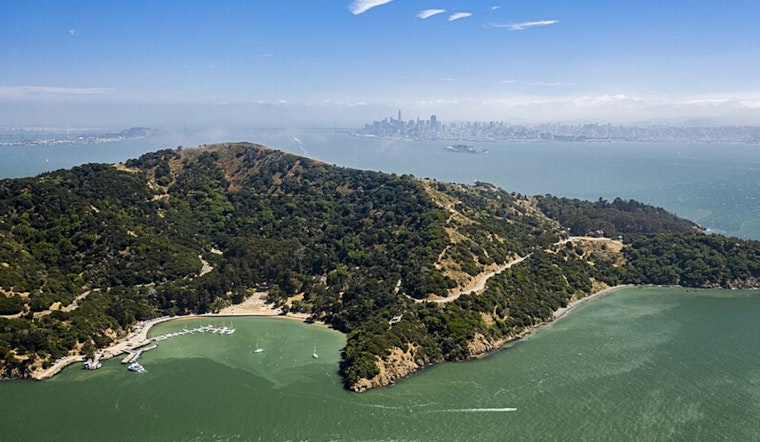
A determined coyote caught on camera last week swimming through the choppy waters of Raccoon Strait has become the latest symbol of an evolving ecological experiment happening right in San Francisco Bay. The footage, captured by Angel Island State Park staff, shows one of the island's resident coyotes making what appeared to be a scouting mission toward the Tiburon shore, about a quarter-mile from its island home.
The swimming coyote initially fooled park staff, who mistook it for a seal until its distinctive large ears came into view above the waterline. Park interpreter Casey Dexter-Lee, who has worked on Angel Island for 24 years, told reporters the coyote made about a half-mile round trip before turning back to Ayala Cove.
From Zero to Ecosystem Engineers in Eight Years
What makes this swimming sighting particularly remarkable is how it represents the complete ecological transformation of Angel Island since 2017. For as long as California State Parks staff could remember, coyotes simply didn't exist on the 1.2-square-mile island. Then, as Bay Nature details, a disbelieving ranger spotted one, then another, and another.
The story began when parks employee Mikayla Smith first saw a coyote on the lawn of staff residences in 2017, only to be met with skepticism—colleagues insisted coyotes didn't exist on the island. Her sighting was dismissed until ranger Andrew Luskus, experienced from his time in Death Valley, made split-second eye contact with a coyote while biking the island's perimeter trail. "Are you sure it wasn't a dog?" fellow staff asked. He was certain.
Today, that original pioneering pair has grown into a thriving population of approximately 14 coyotes, fundamentally altering the island's ecosystem through what scientists call a "trophic cascade"—a domino effect that begins when top predators impact their prey and ripples through the entire food chain.
The Deer Problem That Solved Itself
The coyotes' arrival inadvertently resolved a decades-old environmental challenge. In 1915, the U.S. Army introduced about 20 Columbian black-tailed deer to Angel Island for hunting, stopping when it became a state park in the 1950s. Over the next 50 years, the deer population exploded to as high as 300—possibly the state's highest documented density, a record likely still standing in California.
"The deer were starving and skinny, and there was a concern for the impacts on the island's cultural plants and vegetation," explains Bill Miller, a California State Parks environmental scientist. Native plants that deer fed on include sagebrush, chamise, and purple needlegrass. Various solutions were proposed over the years, including relocating deer, introducing contraceptives, or—most relevantly—bringing in coyotes as natural predators.
Wildlife biologist Dale McCullough from UC Berkeley actually proposed relocating coyotes to Angel Island in 1981, advocating for a small pack of six to prey on sick deer and fawns damaging the island's vegetation. The proposal fell flat after public and animal rights groups pushed back, leading the California Department of Fish and Game to withdraw support. Instead, state parks implemented periodic deer culling programs. But then, as Miller notes, "the culling stopped and the numbers of deer on the island apparently stabilized... Shortly after, the coyotes showed up."
Nature's Own Population Control
The impact has been swift and dramatic. Deer that once fearlessly lounged on the visitor center lawn now "timidly skirt among shrubs and bushes," according to Bay Nature. Casey Dexter-Lee, who has lived on the island for 14 years, observed the change firsthand: "Around the time the last ferry left, the deer would come and hang out on the lawn in the visitors center. Now, they aren't in this open space as much and are a bit more cautious."
Since the first coyote litter appeared in 2019, park staff haven't witnessed any deer grow into adulthood, though Miller acknowledges they could be maturing in remote, hidden parts of the island. The evidence of predation is clear—staff have found deer hooves in coyote scat, confirming the new predators are successfully targeting fawns and does.
Raccoons have virtually vanished as well. Once a persistent nuisance stealing from visitors and begging for food scraps, they're no longer a problem. The change has been so complete that Dexter-Lee hopes the coyotes might also help control Norway rats, which arrived on passing ships and have disrupted native plant growth.
Swimming Predators and Regional Expansion
The Angel Island coyotes represent a broader pattern of urban expansion across the Bay Area. Ferry operators have become accustomed to these aquatic crossings—Ashley Kristensen, operations manager at the Angel Island-Tiburon Ferry, has witnessed coyotes swimming across Raccoon Strait multiple times during her 15 years on the job. According to Bay Nature, captain Aaron Swerkes has spotted the swimming coyotes several times over his three decades of Bay sailing.
"We do know coyotes have been expanding south into Marin County and to San Francisco. They're already taking exploratory things like going across the Golden Gate Bridge," Brett Furnas, a California Department of Fish and Wildlife quantitative ecologist, told SF Gate. "So it's not a stretch that they would, maybe by accident, get swept across to Angel Island, or intentionally do that."
Island Paradise with Limits
The coyotes appear to be living in what Bay Nature describes as "an island paradise." They regularly feast on fallen fruit beneath Catalina cherry and Canary Island date palm trees, encounter visitors and staff at all hours, and leave scat scattered across trails and roads. They loiter around picnic tables where visitors might drop crumbs, unrestricted by their typical dawn-and-dusk activity patterns.
But their growth faces natural constraints. "There's only so much food and space to support coyotes on an island," notes Furnas, who leads the California Department of Fish and Wildlife's investigation of Angel Island's coyote and deer populations. The isolation also raises concerns about genetic inbreeding—a healthy population requires genetic mixing with mainland coyotes.
The Endemic Species Question
While the coyotes have successfully controlled invasive deer and raccoon populations, scientists worry about their impact on the Angel Island mole—a subspecies found nowhere else on Earth. This endemic mole is slightly larger than other East Bay moles, with a broader nose, bigger feet, heavier front claws, and darker coloring. As Miller explains, "The Angel Island mole is a subspecies of mole that is only found on this island. But I don't know what their numbers are or if coyotes are eating them or not."
Ongoing Research and Future Implications
Since September, the California Department of Fish and Wildlife has been collecting coyote scat and installing wildlife cameras to determine genetics, diet, and movement patterns. The island's isolation presents a unique opportunity to study how coyotes control deer populations in a closed environment. Furnas suspects they're primarily targeting fawns, whose first-year survival often limits population growth.
The research aims to answer critical questions: Do coyotes stay on Angel Island when there's sufficient food, or do they continue traveling to the mainland? How do they maintain genetic diversity? The department hopes to provide comprehensive deer and coyote population estimates within a year, data that will inform future wildlife management decisions as the Bay Area continues grappling with increasing human-wildlife interactions.
Why This Story Matters Now
While the swimming incident occurred six days ago, it represents the latest chapter in an ongoing ecological transformation that scientists are still racing to understand. As environmental scientist Miller notes, the plant life hasn't changed yet, but predictions suggest less deer grazing pressure could lead to more diverse vegetation, denser forests, and particularly more oak trees—a transformation that could reshape Angel Island's landscape for generations to come.



.jpg)