

























































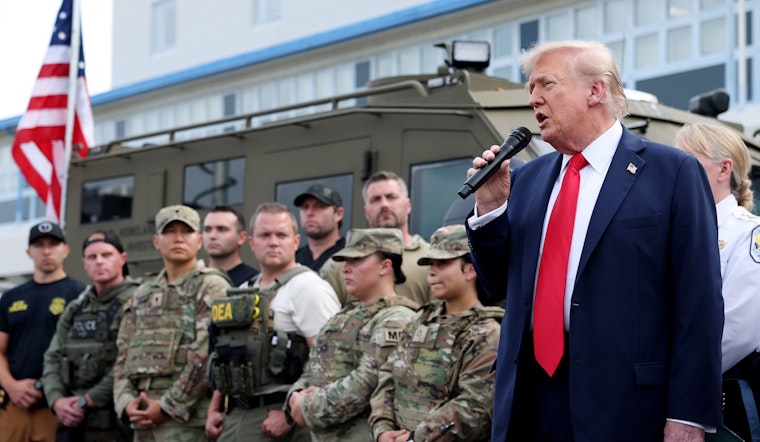
A federal judge handed California a decisive victory today, delivering a scathing 52-page rebuke to the Trump administration's unprecedented militarization of downtown Los Angeles. The ruling validates what California officials have argued for months: deploying thousands of troops against protesters crossed a constitutional line that hasn't been breached in nearly 60 years.
U.S. District Judge Charles Breyer didn't mince words in his decision, finding that Trump's deployment of 4,000 federalized California National Guard members and 700 Marines constituted a "willful" violation of the 1878 Posse Comitatus Act. The judge's detailed findings paint a picture of armed soldiers "whose identity was often obscured by protective armor" systematically using "military vehicles to set up protective perimeters and traffic blockades, engage in crowd control" throughout the city, according to NBC News.
When Federal Buildings Became Military Zones
The judge's ruling meticulously documented how federal troops transformed downtown LA's civic heart into something resembling occupied territory. The military presence centered around two key federal facilities that became flashpoints during the summer's immigration protests: the Edward R. Roybal Federal Building and the adjacent Metropolitan Detention Center in the heart of downtown's Civic Center district.
What started as purported "building protection" quickly morphed into something far more extensive, according to Breyer's decision. While military publications like Stars and Stripes initially described troops as maintaining "a relatively stationary posture," trial evidence revealed a much more active role in civilian law enforcement—exactly what the Posse Comitatus Act was designed to prevent.
Breaking 147 Years of Constitutional Precedent
The Trump administration managed to achieve something no president had attempted since 1965: federalizing state National Guard troops to suppress civil unrest without the governor's consent, according to Al Jazeera. The last time this happened, President Lyndon B. Johnson was protecting civil rights marchers in Selma, Alabama—a far cry from Trump's immigration crackdown.
Judge Breyer clearly saw through the administration's attempts to justify the deployment. "President Trump and Secretary Hegseth have stated their intention to call National Guard troops into service in other cities across the country," he wrote, describing this as tantamount to "creating a national police force with the President as its chief."
The Law Trump Tried to Ignore
The Posse Comitatus Act exists for good reason. Passed in 1878 after Reconstruction, this one-sentence law states: "Whoever, except in cases and under circumstances expressly authorized by the Constitution or Act of Congress, willfully uses any part of the Army or the Air Force as a posse comitatus or otherwise to execute the laws shall be fined under this title or imprisoned not more than two years, or both." The Brennan Center for Justice notes this law emerged from America's hard-learned lessons about military interference in civilian affairs.
The depth of military involvement in civilian policing should alarm anyone who values constitutional limits on federal power. Trial testimony revealed that National Guard soldiers accompanied immigration officers on a staggering 75% of their missions, according to CalMatters. That's not protecting federal property—that's creating a domestic army.
How LA's Summer of Resistance Began
The chain of events that led to today's ruling started with what many saw as heavy-handed federal overreach. On June 6, 2025, ICE agents swept through LA, targeting day laborers waiting for work at a Home Depot parking lot and serving warrants at local businesses. More than 40 people were rounded up in operations that ABC News documented as sparking widespread community outrage.
What followed was a escalating confrontation that saw protests spread from downtown LA to Paramount and Compton. Rather than allowing local authorities to handle the situation—as they'd successfully done during past demonstrations—Trump opted for the nuclear option: federalizing the California National Guard.
Local Officials Stand Their Ground
California's leaders didn't roll over. Governor Gavin Newsom immediately called the deployment "purposefully inflammatory" and filed the lawsuit that led to today's victory. Los Angeles Police Chief Jim McDonnell was refreshingly direct in his assessment, telling "CBS Morning News" that "We don't need the National Guard, and they're not here to help us right now."
Mayor Karen Bass hit the nail on the head, describing the deployment as a "chaotic escalation" that put communities at risk rather than protecting them. The economic impact was real: businesses closed, events were cancelled, and people stayed home out of fear of the military presence on their streets.
California's Constitutional Victory
Attorney General Rob Bonta's reaction to today's ruling captured the stakes perfectly. The decision "affirms that President Trump is not King, and the power of the executive is not boundless," he said in a statement from his office. After months of what Bonta called "political theater, using National Guard troops and Marines as pawns," California finally got its day in court.
Governor Newsom's social media response was characteristically blunt, posting on X: "DONALD TRUMP LOSES AGAIN. The courts agree -- his militarization of our streets and use of the military against US citizens is ILLEGAL."
This wasn't just a legal victory—it was a vindication of California's principled stand against federal overreach. The state's legal team successfully demonstrated that constitutional law still matters, even when a president claims unlimited authority.
The Fight Continues
Judge Breyer showed judicial wisdom in his implementation timeline, delaying the ruling's effect until September 12 to allow for appeals, according to NPR. Some 300 National Guard troops remain in the LA area, though they're now legally constrained from the law enforcement activities the judge found so troubling.
The Trump administration will likely appeal—they have little choice after such a comprehensive legal defeat. But the Ninth Circuit will now have to grapple with Breyer's thorough documentation of constitutional violations.
What This Means for Presidential Power
This case represents far more than a dispute over one deployment. As CNN noted, it's "a crucial moment for determining how much power a U.S. president can lawfully exercise over the military on domestic soil."
The timing couldn't be more critical. Trump has already floated similar deployments to Democratic-led cities like Chicago, Baltimore and New York, according to the Associated Press. Today's ruling puts those plans on shaky legal ground.
California's lawyers made a compelling slippery-slope argument that deserves attention: if military forces can accompany ICE agents, what stops them from accompanying "federal food safety inspectors, medical fraud investigators or federal voting rights officials" to monitor polling places? The implications, as CalMatters reported, could fundamentally alter the relationship between federal power and local communities.
Judge Breyer's ruling doesn't just protect Los Angeles—it reinforces constitutional principles that protect every American community from the prospect of federal troops patrolling their streets. In an era when democratic norms face constant pressure, California's legal victory represents a crucial defense of the boundaries that keep America from sliding toward authoritarianism.
The 300 troops still stationed in LA serve as a reminder that this constitutional battle isn't over. But today's ruling proves that courts can still serve as a check on executive overreach, and that California's resistance to federal militarization was legally sound from the start.




