

























































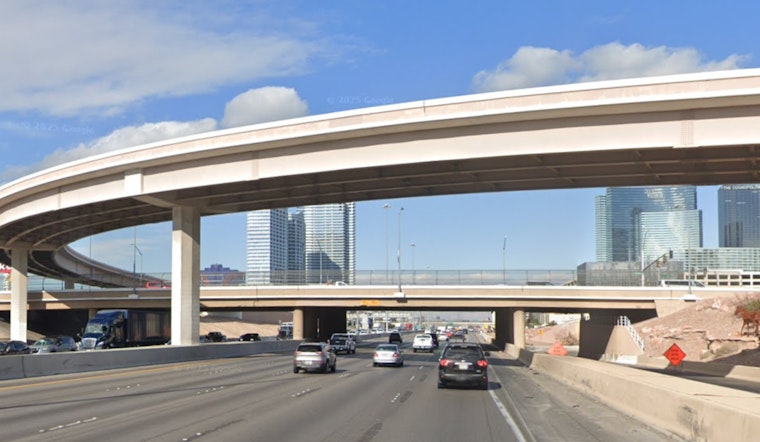
When Las Vegas resident Alex Tamayo spotted what appeared to be a troubling gap in an Interstate 15 overpass bridge last week, he did what any concerned citizen would do—he reached out to local media. What seemed like a potential structural failure turned out to be a textbook example of proper bridge engineering.
According to KTNV, Tamayo sent photos of a gap in the northbound section of I-15 that bridges the off-ramp to West Spring Mountain Road to Channel 13's consumer advocate Darcy Spears. He was concerned that the high volume of traffic was making the gap wider, prompting his inquiry to the popular "Darcy, What's the Deal?" segment.
NDOT Sets the Record Straight
After investigating Tamayo's concerns, the Nevada Department of Transportation provided a reassuring explanation. The agency confirmed that the bridge is performing "within the expected range and has no structural issues," as reported by KTNV. The key revelation: "What appears as a gap is an expansion joint, designed to accommodate the bridge's natural thermal expansion and contraction."
This distinction is crucial for understanding bridge safety in Nevada's desert climate, where temperatures can fluctuate dramatically between scorching summer days and cool winter nights. Expansion joints are engineered features that allow concrete and steel structures to grow and shrink with temperature changes without compromising structural integrity.
Nevada's Impressive Bridge Safety Record
The incident highlights Nevada's broader infrastructure success story. As noted by KTNV, NDOT notes that Nevada consistently ranks among the best in the nation for bridge safety and condition, with all bridges inspected at least every two years, and older or more stressed structures checked more frequently.
According to the Las Vegas Review-Journal, the American Road and Transportation Builders Association's 2023 report shows the Silver State has the second-safest bridges in the U.S., behind only Arizona. Of the 2,090 bridges in Nevada, only 25 are classified as structurally deficient, meaning one of the major elements of the structure was in poor condition.
The state's infrastructure recently earned recognition in the American Society of Civil Engineers 2025 report card, receiving a C-plus grade—the highest Nevada has ever achieved, as per the Review-Journal. Nevada is one of only four states to receive a C+ grade, along with Georgia, Utah and Wisconsin.
Infrastructure Challenges Ahead
While Nevada's bridges currently rank among the safest nationally, funding challenges loom on the horizon. As reported by The Nevada Independent, NDOT manages nearly 60 percent of the state's bridges, with the remainder under local jurisdiction. More than a quarter of the state's bridges are more than 50 years old, and another 250 will reach that age by the end of the decade.
The state spends approximately $17 million per two-year budget cycle on bridge preservation, funded through federal money, fuel taxes, and registration fees. However, there is a $133 million backlog in bridge preservation work that would address maintenance, rehabilitation and replacement of bridges, according to the Review-Journal.
Continued Monitoring
For the specific bridge that raised Tamayo's concerns, NDOT confirmed it needs no repairs at this time but will keep monitoring it as part of routine oversight, as stated by KTNV. This approach reflects the state's systematic approach to bridge safety, where regular inspections help identify issues before they become serious problems.





