

























































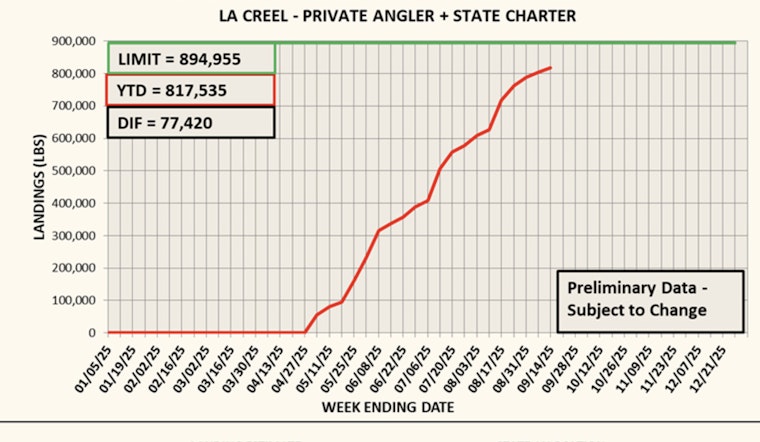
Anglers in Louisiana may need to reel in their plans for red snapper fishing, as stocks are depleting fast. The Louisiana Department of Wildlife and Fisheries (LDWF) announced that as of September 14, a total of 817,535 pounds of fish have been caught this season. This figure represents 91.4 percent of the state's annual allocation set at 894,955 pounds, signaling that the season's end may be closer than expected.
The possibility of the season closure looms large, which will hinge upon the weekly LA Creel estimates. With the allocation nearing its limit, fishermen are warned that the end of the season "could occur as early as the first or second week of October," according to LDWF. While still under 10 percent, anglers should take note that the remaining catch is dwindling, and they are advised to take advantage of the water while they can.
Starting May 1, both state and federal waters opened up for private recreational anglers with the opportunity to fish seven days a week. Rules in place allowed a daily bag limit of four fish per person with a 16-inch total length minimum size limit. The season was set to run until the collective catch approached or reached the state’s allocation limit.
For those looking to partake in these final days of the season, it’s important to remember the necessary permits. "Must possess valid Louisiana basic and Saltwater Recreational Fishing Licenses and a Recreational Offshore Landing Permit (ROLP) (no fee) to fish for or possess Red Snapper," as stipulated by the LDWF. ROLPs are available on the ROLP website and can be saved electronically or printed to be carried while fishing along with other necessary licenses.
Charter fishing has also been affected by the nearing allocation limit. State-for-hire charter vessels cannot venture beyond 9 nautical miles and are confined to state waters for red snapper fishing when the season is active. Federal for-hire charters, which opened on June 1 and closed on September 16, observe federal regulations and may fish in federal waters during their specified season. LDWF has also encouraged the use of descending devices for releasing reef fish to combat barotrauma, a condition that affects fish retrieved from deep waters due to pressure changes.





