

























































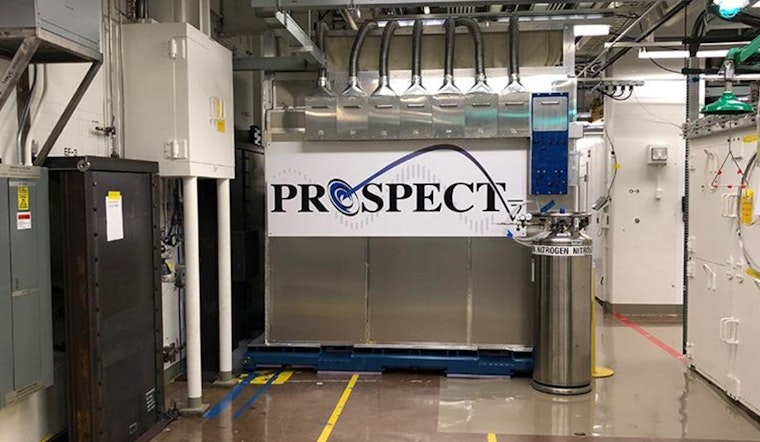
Physicists have been on a meticulous hunt for a hypothetical particle known as the "sterile" neutrino, which, if found, could unveil a novel form of matter that interacts solely with gravity, potentially reshaping our understanding of how the universe evolved; however, recent findings at the Department of Energy’s Oak Ridge National Laboratory (ORNL) have yet to confirm their elusive existence. According to a study published in Physical Review Letters, researchers from various U.S. universities and national laboratories have imposed stringent limits on the likelihood and mass of sterile neutrinos, using data from the Precision Oscillation and Spectrum Experiment I (PROSPECT-I) situated near the High Flux Isotope Reactor at ORNL, which primarily observes electron antineutrinos released from nuclear fission.
The quest to uncover sterile neutrinos is rooted in the peculiar behavior of known neutrinos, which switch between three "flavors" and thereby indicate that they possess mass, however minute, since they are capable of interacting through the weak nuclear force and gravity. Anomalous experimental data and some theoretical models suggest sterile neutrinos might only interact via gravity, which further complicates their detection. "If these new sterile neutrino types exist, then the neutrinos generated by the reactor will have some probability to transform into this sterile type as they propagate from the reactor to the detector," Bryce Littlejohn, a professor at Illinois Tech and one of the paper’s authors, told Lawrence Livermore National Laboratory, elucidating that sterile neutrinos would evade interaction within the PROSPECT detector, resulting in a lower number of detectable neutrinos.
PROSPECT's proximity to the compact nuclear reactor core has enabled the experiment to investigate sterile neutrinos with higher mass values relative to its counterparts, which operate farther from larger reactors, placing the strongest limits thus far in this specific high-mass area and minimizing the probability that recent unusual findings from Russian reactor and radioactive source neutrino investigations are linked to sterile neutrinos. Utilizing novel techniques to enhance data extraction and improve background noise rejection, the PROSPECT-I detector, despite previous technical difficulties, has now achieved a precision that undercuts the evidence for sterile neutrinos, conveyed through the experiment's 10th physics publication based on 2018 data.
The ORNL team has not only confronted the sterile neutrino enigma but extended its research to produce the most precise measurement of the uranium-235 energy spectrum and to innovate in antineutrino event reconstruction with machine learning methods—as Alfredo Galindo-Uribarri, a distinguished scientist at ORNL and an adjunct professor at the University of Tennessee, Knoxville, disclosed, applauding former graduate students Diego Venegas-Vargas, Xiaobin (Jeremy) Lu, and Blaine Heffron for optimizing the dataset used in the study. Going forward, the collaboration seeks to refine the detection through upgrades to the PROSPECT detector and unite with additional experiments to extend the search across various mass regimes. This initiative garners support from the Department of Energy Office of Science, the Heising-Simons Foundation, and several academic and research institutions.





