

























































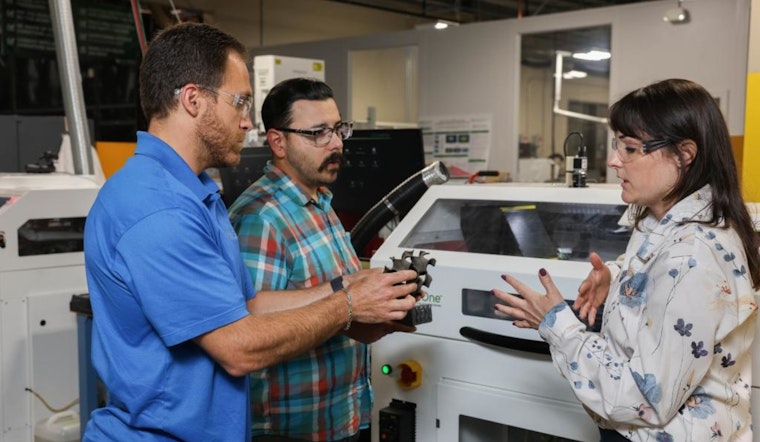
In a recent breakthrough at Oak Ridge National Laboratory, scientists have successfully engineered a new method for 3D printing with ceramics that could revolutionize the manufacturing of chemical reactors needed for pharmaceutical and chemical processing. According to ORNL's announcement, the critical improvement solves the persistent issue of scalability, allowing for larger, leak-proof parts to be reliably produced, an essential component for high-throughput reactors.
The advanced post-processing technique, as described by ORNL, pairs binder jet additive manufacturing (BJAM) with a robust joining method, allowing small, 3D-printed segments to be assembled into significant components that maintain gas-tight integrity, a feature crucial in handling corrosive chemical substances and withstanding high temperatures, it has proven to be the first-known leak-tight joint using additive manufacturing methods thereby paving the way for BJAM assemblies that can meet the requirements of scalability within industrial applications. Lead researcher Trevor Aguirre, belonging to ORNL's Extreme Environment Materials Process Group, emphasized the impact of this development, stating, "Ceramic 3D printing allows fabrication of intricate and high-performance components that are difficult to achieve with traditional manufacturing methods."
A major facet of this innovation is its economic advantage; BJAM technology is known for being cost-efficient, as it fuses layers of powder with a binder to craft solid objects. The application of ceramic 3D printing extends beyond chemical reactors, providing possibilities for sectors such as aerospace that demand materials capable of sustaining extreme environments. Following this advancement, and duly recognized for their significant contributions to additive manufacturing, the ORNL team has been awarded the SME’s 2025 Dick Aubin Distinguished Paper Award.
Other ORNL researchers who had their hand in this project include Dylan Richardson, Corson Cramer, Amy Elliott, and Kashif Nawaz the research funded by both DOE's Advanced Research Projects Agency-Energy and its Solar Energy Technologies Office, with the work taking place at the Manufacturing Demonstration Facility, which is supported by DOE’s Advanced Materials and Manufacturing Technologies Office, is itself a part of a wider national network aimed at transforming U.S. manufacturing through innovation. UT-Battelle, which manages ORNL for the DOE's Office of Science, boasts supporting basic research in the physical sciences more than any other entity in the United States.





