

























































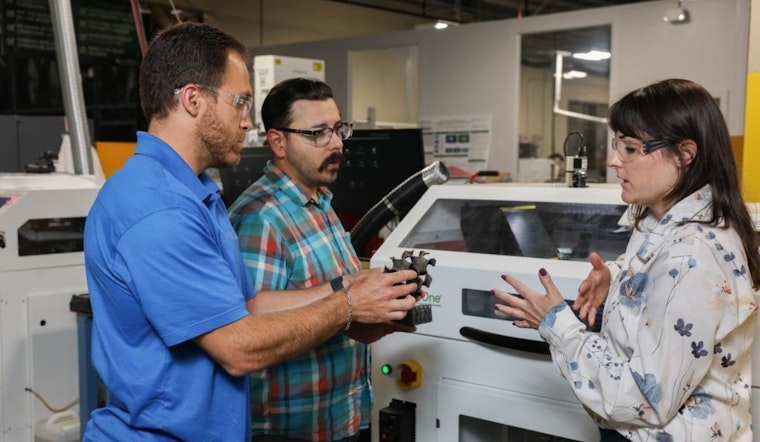
In a significant breakthrough, scientists from the Oak Ridge National Laboratory in collaboration with Dimensional Energy, have made strides in the field of ceramic 3D printing, a development that could reshape chemical reactor construction. The team, as reported by ORNL, has found a way to fabricate leak-tight ceramic components, a historic challenge for this technology's application in high-throughput chemical reactors where robust and sealed parts are essential.
The innovative approach taken by ORNL enables to consistently create complex and scalable ceramic structures, which is critical for larger assemblies used in chemical processing. According to researcher Trevor Aguirre from ORNL’s Extreme Environment Materials Process Group, "Ceramic 3D printing allows fabrication of intricate and high-performance components that are difficult to achieve with traditional manufacturing methods." This paves the way for next-generation reactors that require high-temperature resistance, chemical stability, and mechanical strength, as detailed by ORNL.
With Dimensional Energy taking charge on the method's development, the team has been able to evaluate multiple design configurations, ensuring optimal structures capable of maintaining gas-tight integrity. Through advanced post-processing techniques, the bonding and sealing of ceramic segments have been significantly improved. This collaboration also opens the door to cost-efficient production of large-scale components, leveraging binder jet additive manufacturing (BJAM), where powder layers are fused with a binder.
According to ORNL, the research team, which included experts like Dylan Richardson and Amy Elliott from ORNL, and Bhargavi Mummareddy and Bradley Brennan from Dimensional Energy, has not only met increasing demand but also set the stage for broader adoption of this tech in fields like aerospace. They were recognized with SME's 2025 Dick Aubin Distinguished Paper Award and have published their findings in the Ceramics International journal.
Brennan, chief science officer for Dimensional Energy, highlighted the potential of ceramics for specialized applications in chemical refineries, citing their properties as vastly superior to metal alloys. He noted that manufacturing large, complex ceramic parts and creating robust, leak-tight connections between them remains challenging. Brennan also pointed to the success of the project, which received funding from the DOE's Advanced Research Projects Agency-Energy and the DOE’s Office of Energy Efficiency and Renewable Energy. Researchers are optimistic that this project can significantly impact U.S. manufacturing, inspiring and catalyzing its transformation.





