

























































In a bid to unravel the complexities of quantum materials under duress, Oak Ridge National Laboratory (ORNL) has teamed up with several national labs and the University of Tennessee, Knoxville. The four-year partnership aims to leverage high-performance computing (HPC) to gain insights into how such materials act when, for example, their quantum mechanical properties are nudged out of balance by various external forces. The project, known as Controlled Numerics for Emergent Transients in Nonequilibrium Quantum Matter (CONNEQT), draws together expertise from Los Alamos and Lawrence Berkeley national laboratories, along with SLAC National Accelerator Laboratory.
Nonequilibrium quantum materials—intrigued by the application possibilities in quantum computing and information technologies—are a cornerstone of the collaboration. Given that real-world scenarios subject these materials to constant stimuli like heat and energy flow, researchers are working to understand their out-of-equilibrium properties. These conditions may reveal new and exploitable traits of matter, usually concealed during equilibrium. According to a report by ORNL, "Driving these materials out of equilibrium to manipulate the delicate balance between their complex interactions has emerged as a powerful strategy to engineer quantum phenomena on demand," a statement asserted by Thomas Maier, a distinguished ORNL research staff member.
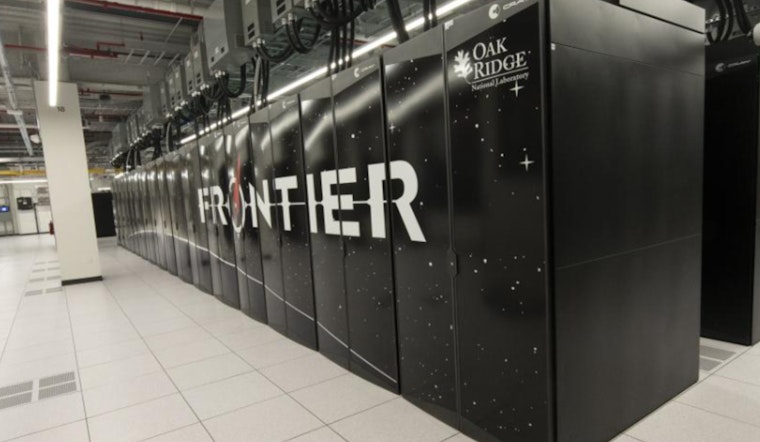
The ambitious CONNEQT initiative seeks to bridge the divide between current theoretical and computational models, and experimental data. By harnessing the power of leadership-class exascale supercomputers, like ORNL's groundbreaking Frontier, researchers envision developing more predictive modeling capabilities for unconventional superconductors and quantum spin liquids. This could pave the way for a deeper understanding of non-linear quantum phenomena. "By leveraging leadership-class exascale computing, we aim to revolutionize computational modeling of transient emergent behavior in quantum materials with strong many-body interactions and deliver a new fundamental understanding of nonlinear quantum phenomena," Maier told ORNL.
Over the course of the next four years, the team is charged with the goal of evolving a computational framework that is unbiased and can meticulously dissect what happens when interacting electron systems are subjected to external force fields. In the trenches of advanced modeling and employing benchmark supercomputers, they are hoping to clarify the complex behaviors that electrons exhibit, giving rise to composite designs and arrangements in these out-of-equilibrium quantum materials. Funding support for these high-tech collaborative explorations is provided by the Scientific Discovery through Advanced Computing program, nurtured by DOE's Office of Science, Advanced Scientific Computing Research and Basic Energy Sciences, Division of Materials Sciences and Engineering.





